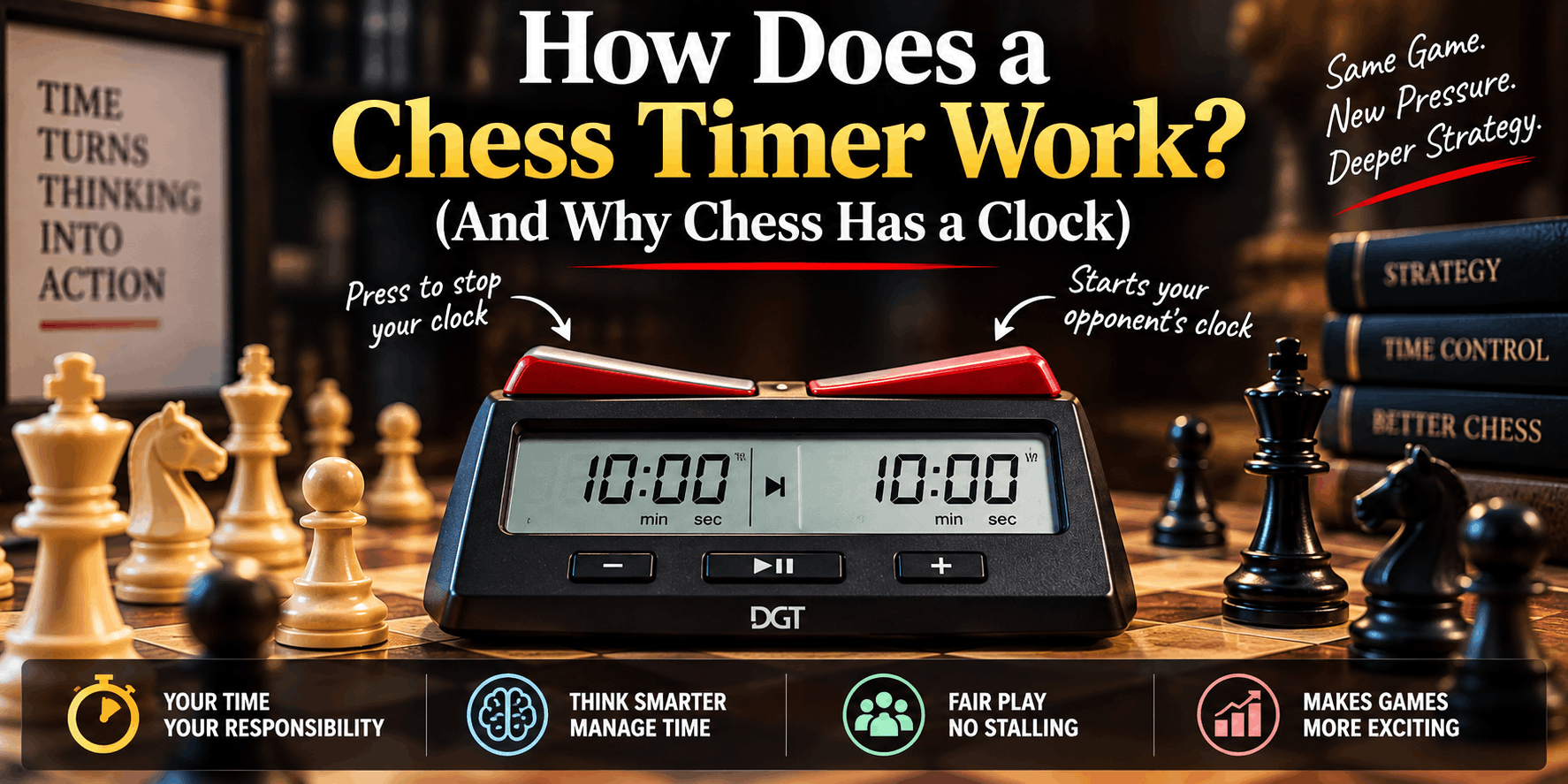
It says: 10+5. Every player begins with 10 minutes. After each move, they get 5 seconds added back. That is the full idea. No extra rules are hidden in it.
Once you see that pattern, other time controls look familiar too, whether you are on Chess.com, Lichess, or reading a time format on a tournament board.
The basic formula
[starting minutes] + [seconds added per move]
- 10+5 → 10 minutes on the clock, +5 seconds every time you press
- 5+3 → 5 minutes on the clock, +3 seconds every time you press
- 3+2 → 3 minutes on the clock, +2 seconds every time you press
- 1+0 → 1 minute on the clock, nothing added, ever
The number before the plus sign is your base time. The number after it is your increment. Base time is what you start with. Increment is what you earn back, move by move, for the rest of the game.
After 40 moves of Play 10+5, you have not used 10 minutes. You've used 10 starts, but you've also got 40 x 5 seconds which equals more than 3 minutes you've come back with during those 10 starts. That is why you find 10+5 games last longer than 10+0 games, despite the fact that they appear the same.
Where the pipe symbol comes from: 15|10
Rather, you will get the same thing, but with a vertical bar. 15|10, 3|2, 1|1.
Popularized by Chess.com, this format has the same meaning as the plus version. 15 minutes to start play 10 seconds. It has been the official time control for the FIDE World Rapid Championship, so you will hear this time control mentioned often in the coverage of the rapid events.
Lichess tends to use the plus sign. Chess.com leans toward the pipe. Neither is more "correct." If you're bouncing between platforms, just remember: same two numbers, same meaning, different punctuation.
What "increment" is actually doing
Every time you complete a move and press your clock, the increment gets added before your opponent's clock even starts moving. It's not a bonus you have to earn by playing fast. It happens on every single move, whether you took 1 second or 90.
This is what separates increment chess from the raw sudden-death games of the pre-1990s. Before Bobby Fischer patented the digital increment clock in 1988, a player with 10 seconds left and 15 moves to make in a won endgame could simply lose on time, king and queen against a lone king, game over. Increment fixed that. Even 3 seconds a move, over 15 moves, hands you 45 extra seconds exactly when you need them most.
That's also the practical difference between formats that look similar on paper. A 5+0 blitz game and a 5+3 blitz game feel nothing alike once you're both under a minute. In 5+0, you're racing raw seconds. In 5+3, every move buys you breathing room.
Delay notation: where "d" shows up instead
American tournaments, especially USCF events, often use a different letter entirely: d for delay.
G/30 d5 means Game in 30 minutes, with a 5-second delay.
Delay works differently from increment, and mixing the two up will cost you in an actual game:
| Increment (+ or without "d") | Delay (with "d") | |
|---|---|---|
| Notation example | 30+5, 3+2 | G/30 d5, G/5 d3 |
| What happens each move | 5 seconds added to your clock | Clock waits 5 seconds before draining |
| Can your time grow? | Yes, if you move fast enough | No, it only pauses |
| Unused seconds carry over? | Yes | No |
| Common in | FIDE, Lichess, chess.com | USCF, US scholastic events |
Practically: in 30+5, a fast move can let your clock climb. In G/30 d5, the same fast move just costs you nothing, your total never goes up.
Reading "G" and other tournament shorthand
Tournament wall charts and pairing sheets use a small vocabulary worth knowing on sight:
- G/90 → "Game in 90." The whole game in 90 minutes, no increment, no delay.
- G/60 d5 → 60 minutes, 5-second delay.
- 40/90, G/30 → 40 moves in 90 minutes, then whatever's left is played at Game/30 for the rest.
- 90'/40 + 30' + 30" → The standard FIDE classical control: 90 minutes for the first 40 moves and another 30 minutes for the remaining 30 moves plus a 30-second increment from move 1.
The latter is exactly what serious tournament players work with, and it's constructed of the exact same two components as 10+5, only scaled up to a larger size.
Quick lookup: common time controls and what they mean
| Notation | Base time | Increment/delay | Typical category |
|---|---|---|---|
| 1+0 | 1 min | none | Bullet |
| 2+1 | 2 min | +1s | Bullet |
| 3+0 | 3 min | none | Blitz |
| 3+2 / 3|2 | 3 min | +2s | Blitz |
| 5+0 | 5 min | none | Blitz |
| 5+3 / 5|3 | 5 min | +3s | Blitz |
| 10+0 | 10 min | none | Rapid |
| 10+5 / 10|5 | 10 min | +5s | Rapid |
| 15 | 10 | 15 min | +10s |
| G/30 d5 | 30 min | 5s delay | Rapid (US) |
| 90'/40+30'+30" | 90+30 min | +30s | Classical |
Why the same "10 minutes" plays so differently
Two players can both say "we played 10 minutes" and mean completely different games.
- 10+0: whatever's on the clock when you start is all you'll ever get. Pure sudden death.
- 10+5: you're effectively playing with 15 to 20 minutes of real time once increments are counted across a full game.
- 10+5: You shouldn't be penalized for the final 5 seconds of any single move, but it's close to 10+0 overall.
Add even a little bit, 2 or 3 seconds, and the endgame of the last ten moves changes drastically if you're trying to make it a friendly game and not a frantic one. It is the lowest cost repair in chess.
FAQ
What does 10+5 mean in chess?
Starting time: 10 minutes per player, and 5 seconds for each move you make to your time.
Is 15|10 the same as 15+10?
Yes. The pipe and plus are the same thing and they are different notation conventions of different platforms.
What's the difference between increment and delay?
Increment adds time to your clock every move and that time can accumulate. Delay just pauses the countdown for a few seconds before it starts draining, and nothing is banked.
What does G/90 mean?
"Game in 90." The entire game must be completed in 90 minutes per player, with no increment unless stated separately.
Why do some notations use "d" and others use "+"?
The characters "++" or "|" indicate "plus", often found in FIDE and internet games. “d” is a delay, typical to USCF and US scholastic tournaments. They cannot be substituted for each other, even if they appear similar.