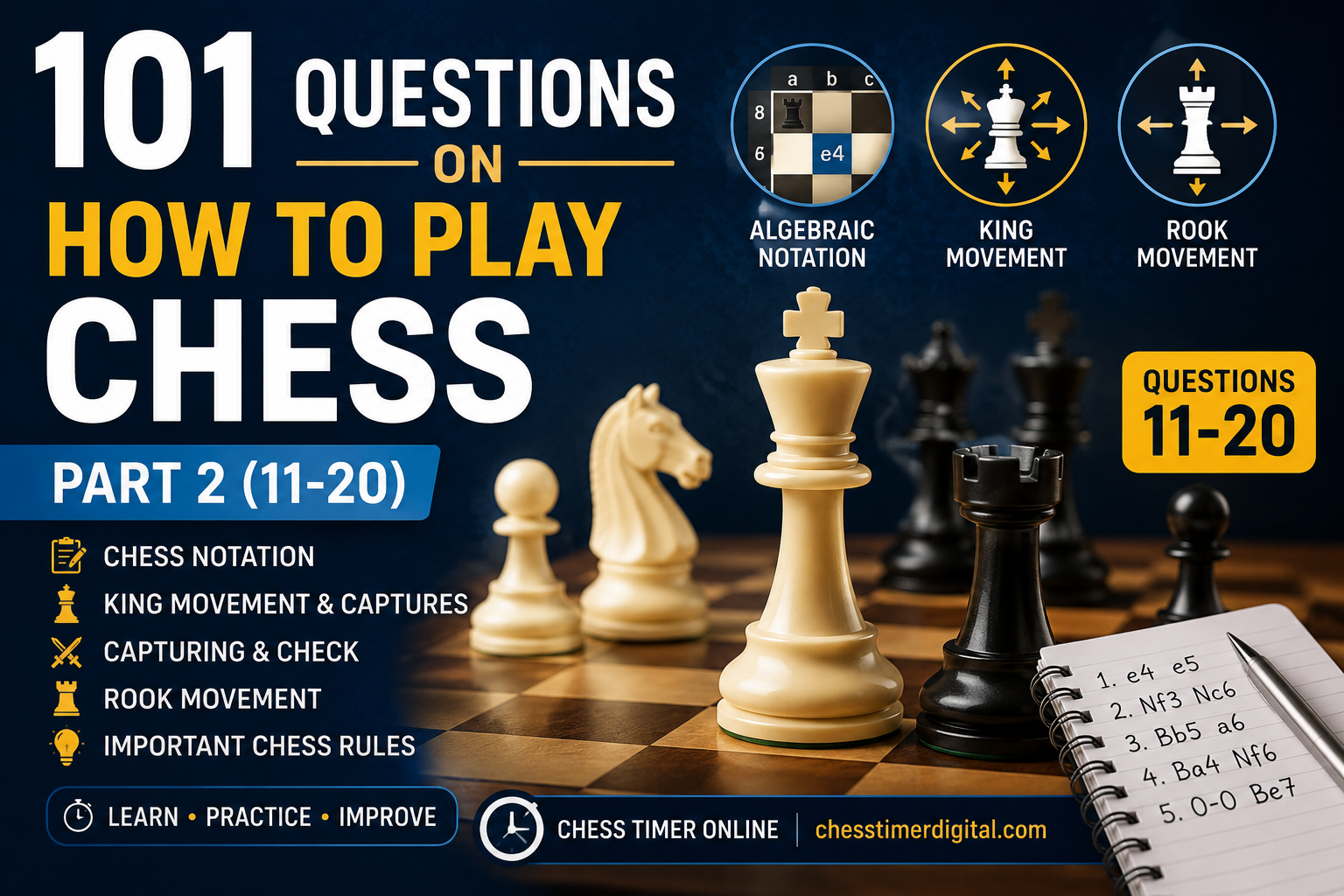
101 Questions on How to Play Chess – Part 2
Chess becomes easier to understand once you learn algebraic notation, piece movement, capturing rules, and the importance of check and checkmate. Below are Questions 11 to 20 explained exactly as in the original text.
11. How can I learn to use algebraic chess notation?
Look at the large, boldface numbers. The longest White-squared diagonal on the board is illustrated with the numbers 1 through 8. This, in fact, is called the "h1-a8 diagonal." What would you call the longest diagonal row of Black squares on the board? (Answer: the "a1-h8 diagonal.")
If we know that the White square with the large 4 on it is called "e4," then what are the names of the squares with a big 5 or 6 on them? (Answers: "d5" and "c6," respectively.)
If the dark square immediately to the left of the big 1 is called "g1," then what are the dark squares immediately to the right of the big 7 and 8 called? (Answers: "c7" and "b8," respectively.)
Simply put, you can figure out the name of any square once you determine which coordinates intersect on it.
Before moving on, choose a dozen or so squares and practice naming them. It is important to become comfortable doing this because most chess books do not have coordinates printed on the sides.
12. How do I apply algebraic notation to the movements of the game?
Both Kings start on the "e file," with White's on the "first rank" and Black's on the "eighth rank." Therefore, we refer to the original square for White's King as "e1," and Black's as "e8."
Notice that each side has already made two moves. (To remind yourself of the opening positions, refer to the beginning of this book. In what follows, don't worry if you don't understand the moves yet. You are not expected to! Just follow along for now.)
In this situation, we would say that White moved a Pawn from the square e2 to the square e4, and Black responded (as the traditional way of speaking describes the play) by moving a Pawn from e7 to e5.
Then White moved a Knight from g1 to f3, and Black responded by bringing a Knight from b8 to c6.
As you can see, this "algebraic language" makes it much easier to talk or write about how and where chess pieces move.
13. What are the abbreviations for the pieces in algebraic notation?
- K = King
- Q = Queen
- R = Rook
- B = Bishop
- N = Knight
Modern algebraic notation does not use a separate abbreviation for the Pawn.
The Pawn gets its name from the file it is on. Thus, at the beginning of a game, the Pawn in front of each King is known as the "e Pawn," (White's or Black's), and the Pawn next to it, in front of each Queen, the "d Pawn," and so on.
How to describe Pawn moves will be explained fully later on, but you should remember that if no symbol is given when recording a move to a given square, it must be assumed that a Pawn has been moved to that square.
14. What is meant by capturing?
In chess, you capture by removing your opponent's piece from the square it is on and replacing it with your own capturing piece.
15. How is capturing done?
All chess pieces can make captures. All chess pieces, except the King, can be captured (if a King were to be captured, that would be checkmate, and the game would be over!).
If more than one capture is possible, only one of them can be made on any given move.
All pieces capture the same way they would move to an empty square, except the Pawn (this notable exception will be discussed later).
16. How does the King move?
The King moves one square in any direction-forward, backward, sideways or diagonally.
The King can move to any square marked with an "X."
17. How does the King capture?
The King can capture any undefended enemy piece on an adjacent square.
The King can never capture a defended piece. (A piece is defended if the square it occupies could be immediately occupied by a piece of the same color, supposing the first piece were not there.)
White's King is on the square d4 and Black's is on e6. Black's Rook is on e3.
Both sides have each made one move. White has captured Black's Rook, which would be recorded as "Kxe3."
The symbol "x" is universally recognized as indicating that a capture has occurred; also, in algebraic notation the piece that has been taken is not represented by name, but rather by the square it is on.
Black's move, going forward one square, would be written "Ke5."
With White's King on e3 and Black's King on e5, if it were White's move he would have access to the squares d3, d2, e2, f2 and f3, while if it were Black's he would be able to move to d5, d6, e6, f6 and f5.
No matter whose move it is, neither White nor Black could move to d4, e4 or f4, as these squares are subject to attack by an enemy piece, and you can never place your King on a square where it is under attack by any of your opponent's pieces.
18. Why is the King restricted in its ability to capture? Does this have any special significance?
It does indeed.
If the King were himself to be captured, the situation would be entirely different from one in which any other single piece were captured: it would be checkmate, and the game would be over.
Because of this special case, the King can never voluntarily place itself under attack.
19. Is there special significance in a situation where the King is under attack but not yet captured?
Yes. This is in fact one of the most important situations in chess.
When the King is attacked and could be captured on the next move if it does not change its position or is not otherwise extricated from this situation, it is said to be in check.
The player whose King is in check must get his King out of check on the very next move.
(He does not necessarily have to move the King. If permissible, he may capture the attacking piece or, in many cases, move another piece between the attacking piece and his King.)
If he cannot do this, checkmate has occurred, and the game is over!
20. How does the Rook move?
The Rook can move any number of squares in a straight line, either horizontally or vertically (but not diagonally), as long as its path is unobstructed.
It can move forward or backward, but in only one direction at a time.
The Rook can move to any square marked with an "X."