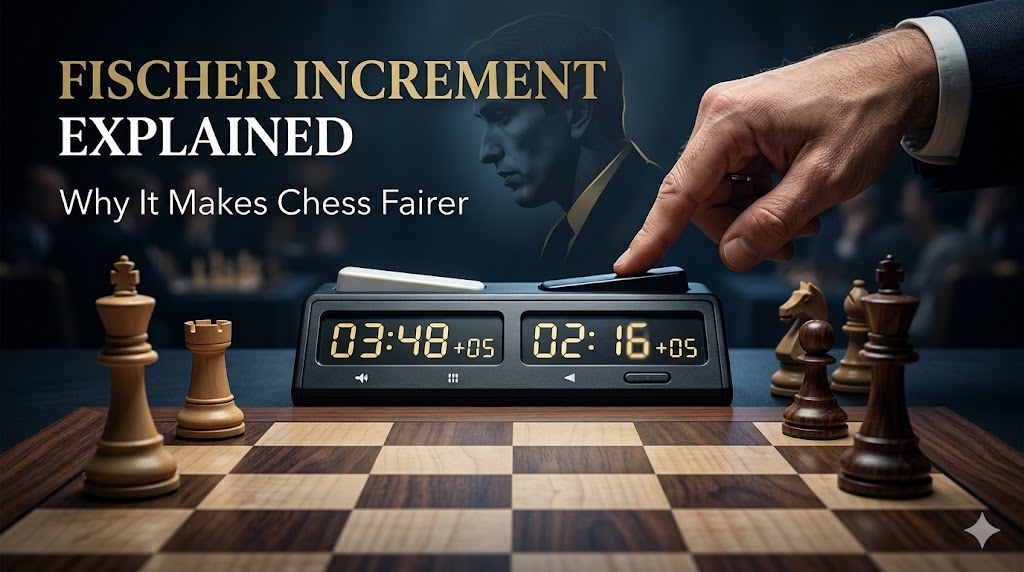
Ever heard of Fischer increment but not sure what is Fischer increment in chess? You're not alone. Many players use it daily without knowing its story or why it revolutionized timing. This simple feature turns chaotic endgames into fair fights.
At chesstimerdigital.com, all our digital chess clocks support Fischer mode. Whether you're setting up 5|5 blitz or 15|10 rapid, understanding increment helps you play smarter. Let's break it down step-by-step.
What Is Fischer Increment?
Fischer increment (or just "increment") adds a fixed amount of time to your clock after every move you complete. Named after chess legend Bobby Fischer, who patented it in 1988, it's now the global standard.
Simple example: In a 10|5 game:
-
You start with 10 minutes.
-
Make your first move → +5 seconds (now 10:05).
-
Make your second move → +5 more (now 10:10).
-
After 40 moves, you've gained 3+ minutes!
Unlike old clocks where time only ran out, increment lets you build time by playing efficiently. Move fast? Your clock actually grows.
How Fischer Increment Works
The process is automatic on modern digital clocks:
-
You make a move and press your clock button.
-
Your timer stops, opponent's starts.
-
After you press, increment adds seconds to your remaining time.
-
Repeat for every move.
Key rule: You only get the full increment if you complete your move. If your flag falls mid-think, no bonus.
This creates a safety net. Even in time trouble, 5 quick moves can buy you a minute to save the game.
Why Bobby Fischer Invented It
Before digital clocks, chess had a big problem. Players could "stall" — think forever on one move, then rush the endgame. Or get flagged unfairly after brilliant play.
Fischer hated this. After retiring, he designed a clock that rewarded move quality over speed. His 1992 match against Spassky used it first. FIDE adopted it soon after.
Fischer's logic: "Chess should be decided by moves, not mechanical flags dropping."
Fischer vs. Other Timing Modes
Not all "extra time" works the same. Here's how Fischer compares:
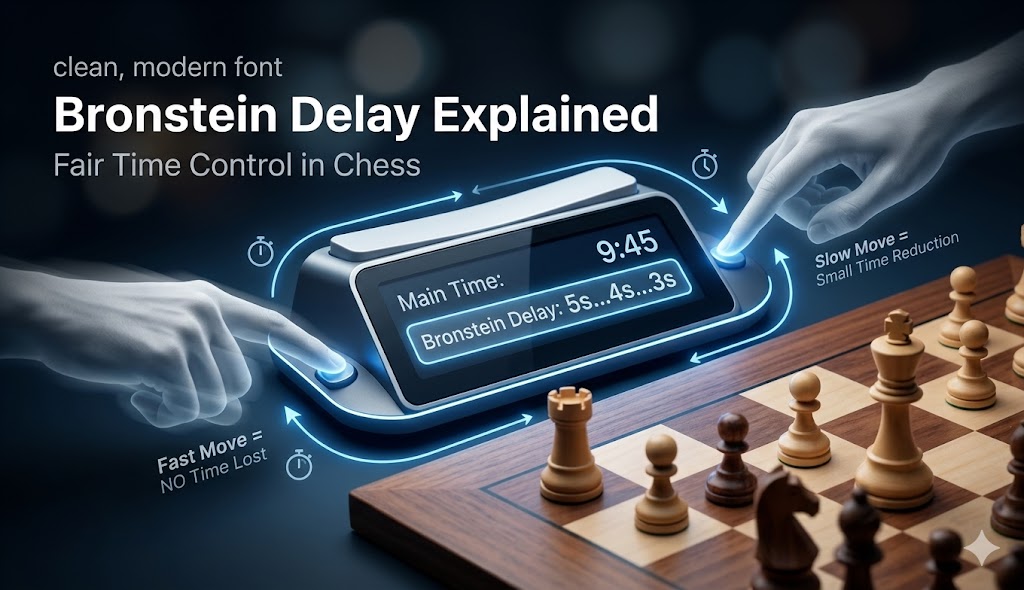
Fischer wins because you can gain time. Bronstein caps at the delay amount.
Real Example: 5|5 Blitz Game
Let's watch increment save a game:
Move 30: You're down to 4:32. Opponent has 6:15.
Move 31: You move in 3 seconds → +5s (now 4:37).
Move 35: Quick defense → now 4:52.
Move 40: Critical tactic → 5:07. You've gained 37 seconds!
Without increment, you'd be flagged by move 38. With it, you win on the board.
Why Fischer Makes Chess Fairer
Old clocks created "flag fever." Players panicked, blundered, or stalled. Increment fixes this:
-
Reduces luck: Skill decides, not one slow move.
-
Endgame fairness: Technical wins possible even in time trouble.
-
Rewards efficiency: Fast, accurate play = time advantage.
-
Less arbitration: Fewer "flag disputes."
Pros like Magnus Carlsen praise it: "Increment lets chess breathe." Even blitz feels strategic.
Best Increment Settings by Format
Beginner tip: Always use increment. 10|0 feels safe but flags you out. 10|5 plays like 15+ minutes .
Common Fischer Increment Questions
Q: Can my clock go over the starting time?
A: Yes! 5|5 can become 8:42 after 70 quick moves. That's the beauty.
Q: What if I move slower than increment?
A: You still get the full bonus. It's not "time used" — it's fixed addition.
Q: Analog clocks support it?
A: No. Only digital. That's why our chesstimerdigital.com clocks shine.
Q: FIDE requires it?
A: Yes for most events. Standard is 90 min + 30s/move.
How to Set Fischer on Digital Clocks
Most clocks (DGT, Chronos, LEAP) have a simple menu:
-
Power on → "Time Control" or "Preset."
-
Choose base time (e.g., 10 minutes).
-
Select "Fischer" or "Increment."
-
Set seconds (5 works for most).
-
Save → Play!
Our clocks have one-tap presets for 5|5, 10|5, 15|10. No fumbling mid-tournament.
Why Buy a Fischer-Compatible Clock?
-
Future-proof: FIDE standard.
-
Versatile: All formats, all skill levels.
-
Practice edge: Train real tournament timing.
-
Portable: Our models fit in your chess bag.
Skip analog relics. Digital Fischer clocks start at affordable prices.
Final Thoughts
What is Fischer increment in chess? It's the game-changer that made timing fair. Bobby Fischer's invention rewards good moves over blind speed. From 1|1 bullet to 90|30 classical, increment keeps chess alive till the last move.
Next game, set +5 seconds. Watch your clock grow while your opponent panics. That's chess at its fairest.

.jpg)