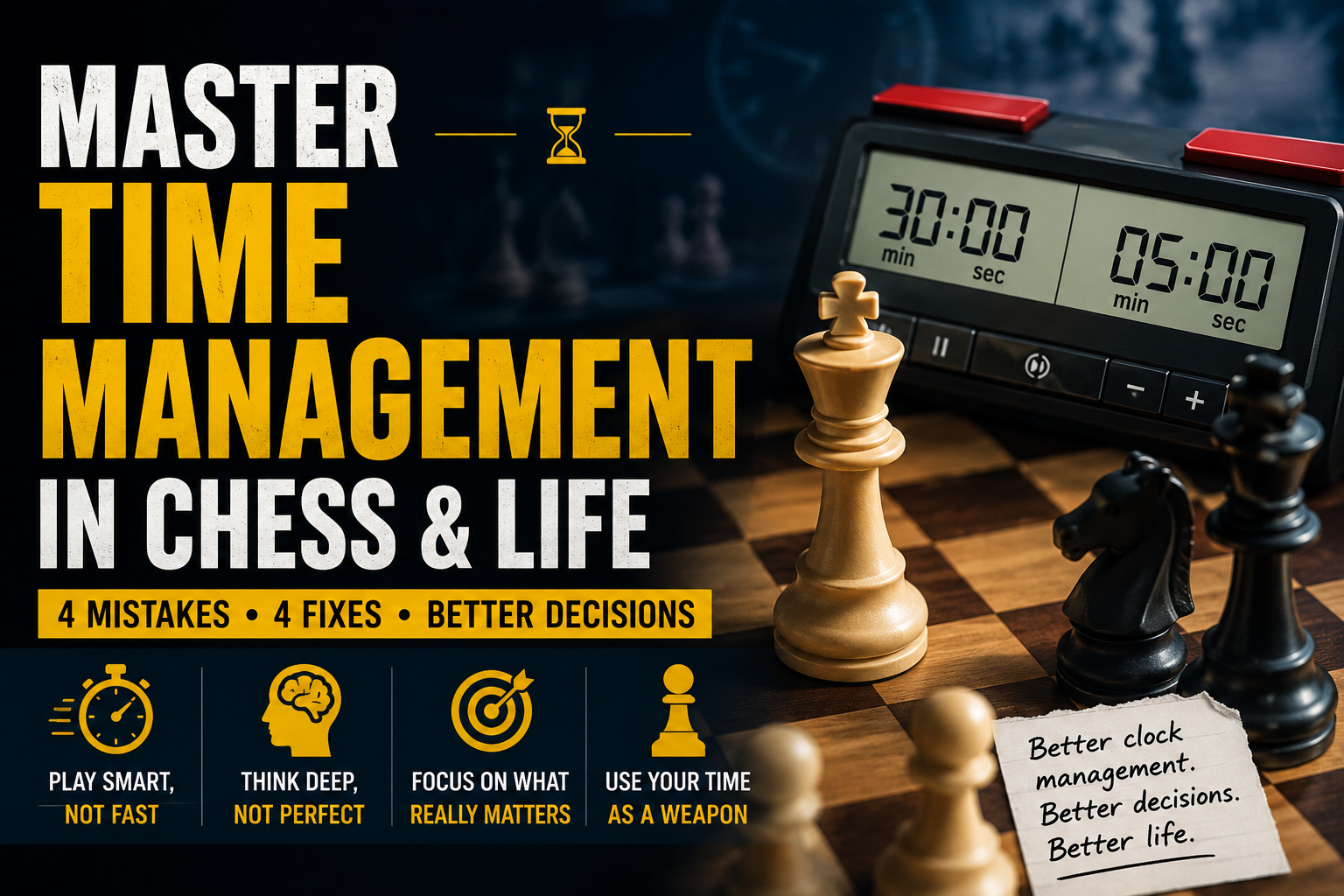
Master time management in chess and you might end up mastering it in life too, kinda. Four mistakes, two worlds, one skill, today we’re looking at how the clock lessons things far beyond the chessboard… somehow.
Think about time the same way you think about chess pieces. It has a kind of value. You can spend it, invest it, waste it, or weaponize it.
Saving time blindly is as bad as wasting it recklessly. The goal, have a time advantage over your opponent. My preference is 10 plus minutes more in classical chess. Time advantage reduces your pressure and increases theirs.
Every chess game is decision making under time pressure just like life. Let's look at the four typical mistakes players make.
Mistake Number One — The Speed Demon
Playing too fast.
I played over 27,000 games online, almost all at 5 minutes plus zero. 5 minute blitz. Game after game after game, years of this. Did I improve? Yes. Any 27,000 games teaches something.
But here’s the brutal truth, honestly. If i’d spent like 5% of that time on longer time controls , or maybe actual study, i’d be like 200 points higher today at least. It feels so close yet kinda gone, you know what i mean. I trained the wrong skill. Speed over accuracy, instinct over calculation. And those habits followed me to longer games.
The blitz addiction is real. You finish a game in 5 minutes. Immediate result. Win or lose, start another. The dopamine hit is instant, but blitz trains you to play fast, to trust your first instinct, to make positions messy and win in your opponent's time trouble.
Then you play a longer game. Suddenly, you have time to think, but your brain doesn't know how. You finish your moves too quickly. You don't use the time you have. Speed became your default and defaults are hard to break.
This mirrors life perfectly. How many important decisions get rushed because we are trained for speed? Career choices made in the weekend. Relationship decisions made impulsively. Financial choices without proper analysis. We treat five-year decisions like five minute problems.
Speed feels productive. But for important decisions, speed is dangerous.
Fix Number One
Here's the fix from the business world, the 80/20 rule. 20% of decisions make 80% of consequences. And these you need to take your time and get them right.
Key skill recognize when you are at those 20% decisions and when you need to engage in deep thinking and calculation.
The remaining 80% look at immediate threats. Spend some time on it. I mean more time than in blitz and rely on intuition.
Mistake Number Two — The Perfectionist
Lara's move 20 pattern.
My daughter Lara had a pattern for years. By move 20, she'd be in time trouble. Every single classical game. She'd spend 15 to 20 plus minutes searching for perfect moves, thinking, calculating, searching for perfection.
Then the middle game would arrive, the most complex phase where you actually need time. And she'd have 30 minutes or less on the clock. Time trouble. Every game for years.
She believed every move needed deep calculation to avoid mistakes. The computer shows one move is 0.033 evaluation. Another is 0.031. Functionally identical positions. But Lara would spend 10 minutes trying to find that perfect move.
This is a mindset problem. Fear of making any wrong move. Perfectionism isn't about which moves matter. It's about believing all moves must be perfect.
This is the perfectionist trap in life also. Refusing to ship the product until it's perfect. Rewriting the email five times before sending. The perfect plan that never gets executed because it's never quite ready.
You think Windows would come to market in the '90s if perfection was the requirement?
The fear isn't about choosing wrong moments to focus. It's about being unable to accept anything less than perfect anywhere.
Fix Number Two
Accept that good enough solutions with time left beat perfect solutions with time trouble.
Chess lesson. Three good enough moves are better than one perfect move causing a blunder later. Give yourself permission to move forward with good enough.
The fix is internal work. Change your definition of what counts as acceptable. Best practical move, not engine's first line.
Mistake Number Three — Missing Critical Moments
Lorena's equal time problem.
My youngest daughter, Lorena, has a different problem. She thinks deeply. That's her superpower. But she thinks deeply in every position. Move five in a known opening position. Five minutes of thought. Move 15 in a quiet middle game. Five minutes. Move 25 in a critical tactical moment. Five minutes. It's time trouble already.
Equal effort, equal distribution of a limited resource. This isn't about perfectionism. She's not searching for perfect moves. This is about not knowing which moves deserve deep thought.
She has the thinking ability. She just hasn't developed the pattern recognition yet to know when to deploy it. All moves feel equally important to her.
Equal distribution of limited resource equals strategic failure. And by move 20, time trouble again.
How many people have this problem in real life? Spending two hours on email, 30 minutes on strategy. Deep focus on the presentation formatting, kind of rushing the real content. Treating $1,000 decisions with $100,000 decisions, like they both need the same analysis time, no difference at all.
Everything feels urgent and gets equal time. Nothing is prioritized and the truly important decisions get rushed at the end when time runs out.
Fix Number Three
The fix is learning to recognize critical moments. Learn to ask, is this the moment that matters?
When should you spend your time bank in chess?
- forcing sequences ahead
- unclear pawn breaks
- king safety decisions
- big exchanges
- strategic turning points
In life:
- career changes
- major financial decisions like buying a house
- relationship crossroads
- anything with long-term consequences
Develop your own criteria for what deserves deep time investment. The skill is telling them apart.
Mistake Number Four — Strategic Blindness
Here's the mistake even experienced players make. So you’ve got like 30 minutes on your clock. Your rival has five minutes, and you are playing at the same pace or slower. Meanwhile, they’re in time trouble, sort of scrambling with the clock, and you start simplifying the position, just calmly trimming it down, you know.
Trade pieces, make it easier for them. You're treating time as a survival tool when it's actually a strategic weapon.
If you have more of any resource in chess, you should use it. More material, press your advantage. Better position, increase pressure. More time, make it complicated.
When your opponent has five minutes left and you have 30, keep the position complex. Give them decisions to make. Force them to calculate under pressure.
Time is material. If you have more, weaponize it. Chess is war. All advantages count.
Fix Number Four
The fix is simple but requires discipline. Keep an eye on the clock often, on yours too, and also on your opponents. Don’t only wonder how much time you have left, but also ask yourself, how much time your opponent has.
Build time in simple positions with increment. Your clock should stay flattish or even go up when nothing's happening. Then spend that bank time on critical decisions.
And when your opponent is low on time, don't help them. Use your advantage.
Four Mistakes, Four Fixes
One skill that transfers to life.
Are you:
- the speed demon
- the perfectionist
- missing critical moments
- strategically blind
Fixes:
- 80/20 rule
- permission to be good enough
- recognize critical moments
- use time advantages strategically
Pick one slip. Start with one correction. Time management in chess becomes time management in life, sorta.
Which of these four mistakes do you mess up the most, in chess or in life?