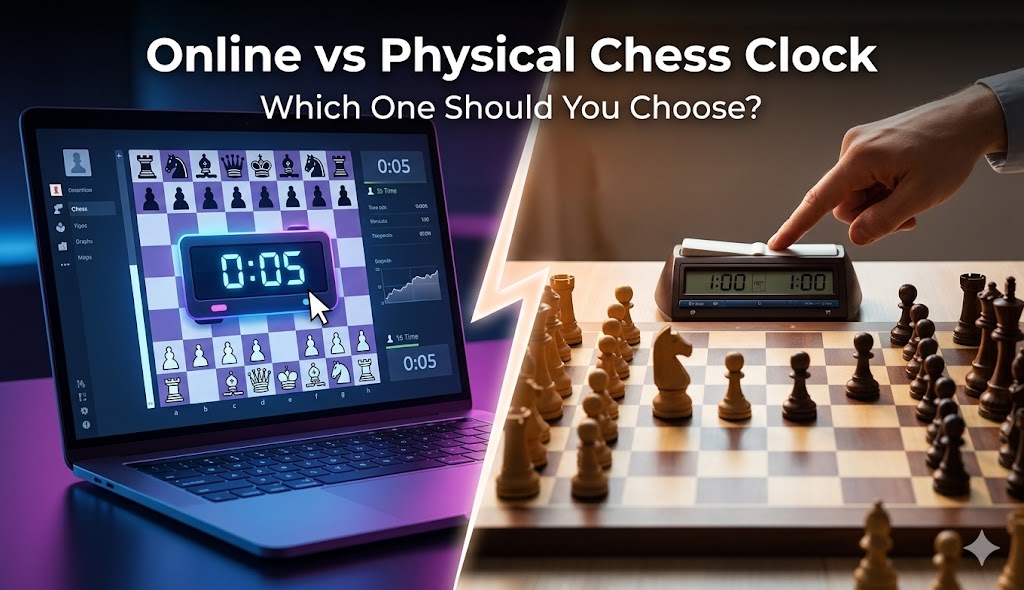
Wondering about online chess clock vs physical clock? Both time your games, but they serve different worlds. Online clocks live in apps like Chess.com. Physical clocks sit between real boards. Each has strengths — and trade-offs.
At chesstimerdigital.com, we craft premium physical digital clocks for tournaments, clubs, and home play. This comparison helps you decide: digital convenience or tactile precision? Let's weigh the pros, cons, and best uses.
What Are They?
Online Chess Clocks: Built into platforms (Lichess, Chess.com). Automatic, no hardware needed. Handles premoves, disconnects.
Physical Chess Clocks: Standalone devices (analog/digital). Placed between players on real boards. Manual setup/press.
Both enforce time controls — but experiences differ wildly.
Core Comparison Table
Online = effortless. Physical = deliberate.
Online Chess Clock: Pros and Cons
Pros
-
Zero setup: Click "Play" — clock runs.
-
Premove magic: Queue obvious moves instantly.
-
Auto-features: Disconnect protection, draw offers.
-
Stats tracking: Graphs time usage, accuracy.
-
Global opponents: 24/7 availability.
-
Free forever: No hardware costs.
Cons
-
No physical feedback: Feels detached.
-
Screen distractions: Chat, ads, notifications.
-
Platform dependency: Downtime, bans affect play.
-
Mouse lag: Premove fails = time loss.
-
No portability for real boards.
-
Less "serious" feel.
Best for: Casual daily games, bullet/blitz marathons.
Physical Chess Clock: Pros and Cons
Pros
-
Tournament authentic: FIDE-approved for rated events.
-
Tactile engagement: Button press = commitment.
-
Distraction-free: Pure focus on board/clock.
-
Works offline: No internet needed.
-
Customizable: Increments, delays, presets.
-
Durable investment: Lasts decades.
-
Social vibe: Shared device builds tension.
Cons
-
Setup hassle: Menu diving for 5|5.
-
Battery worries: Dead mid-game disaster.
-
Learning curve: Analog flags tricky.
-
Cost barrier: Quality starts at $50.
-
No premove: Slower for ultra-fast play.
-
Transport: Bulky for travel.
Best for: Tournaments, club nights, serious home practice.
Detailed Feature Breakdown
Time Controls and Precision
Online: Perfect increments, 0.01s accuracy. Auto-adjusts for lag.
Physical: Digital matches (0.1s). Analog less precise (±2s). Winner: Tie for digital physical clocks.
User Interface
Online: Visual graphs, warnings, pause (friendly games).
Physical: Simple buttons/display. Winner: Online for casual, physical for focus.
Durability and Reliability
Online: Platform crashes rare but happen.
Physical: Drop-proof models last 20+ years. Winner: Physical.
Social Experience
Online: Global chat, spectators.
Physical: Eye contact, table tension, shared rituals. Winner: Physical.
Use Case Scenarios: Which Wins When?
Hybrid tip: Use both — online daily, physical weekly.
Real Player Experiences
Online fans say: "Premove wins bullet. Stats show my time blunders."
Physical fans say: "Button press commits you. No distractions, pure chess."
Tournament players: "Digital physical only — FIDE legal."
Common hybrid: Online for volume, physical for quality.
Cost Analysis Over Time
Online: $0 forever
Physical budget: $50 (basic digital) → 10 years use = $5/year
Physical premium: $150 (FIDE) → $15/year
Value winner: Physical for serious players.
Technical Specs Showdown
Online (Chess.com/Lichess)
Accuracy: Server-synced
Increment: Perfect
Display: Scalable UI
Customization: 100+ presets
Multiplayer: Infinite
Physical Digital (Our Models)
Accuracy: ±0.1s
Increment: Fischer/Bronstein
Display: 1.8" LCD
Customization: 20 presets
Multiplayer: 2 players
Battery: 15 hours rechargeable
Which Should You Choose?
Go Online if:
-
Casual player
-
Bullet/blitz addict
-
Budget $0
-
Love premoves/stats
Go Physical if:
-
Tournament ambitions
-
Club/home player
-
Want focus ritual
-
Serious improvement
Best of both: Physical digital clock + online apps.
Upgrading Your Physical Clock Game
Top features to seek:
-
FIDE certification
-
Rechargeable battery
-
Increment presets (5|5, 15|10, 90|30)
-
Large tactile buttons
-
Low-time beeps
Our chesstimerdigital.com clocks excel here — tournament-tested.
Future Trends: Hybrid Clocks Coming?
Smart clocks with app sync? Live streaming integration? Physical + online merging.
Current edge: Physical digital bridges gap best today.
Final Verdict
Online chess clock vs physical clock? Online wins convenience. Physical wins authenticity.
Most players need both. Online for quantity. Physical for quality and events. Serious chess demands the button-press commitment.