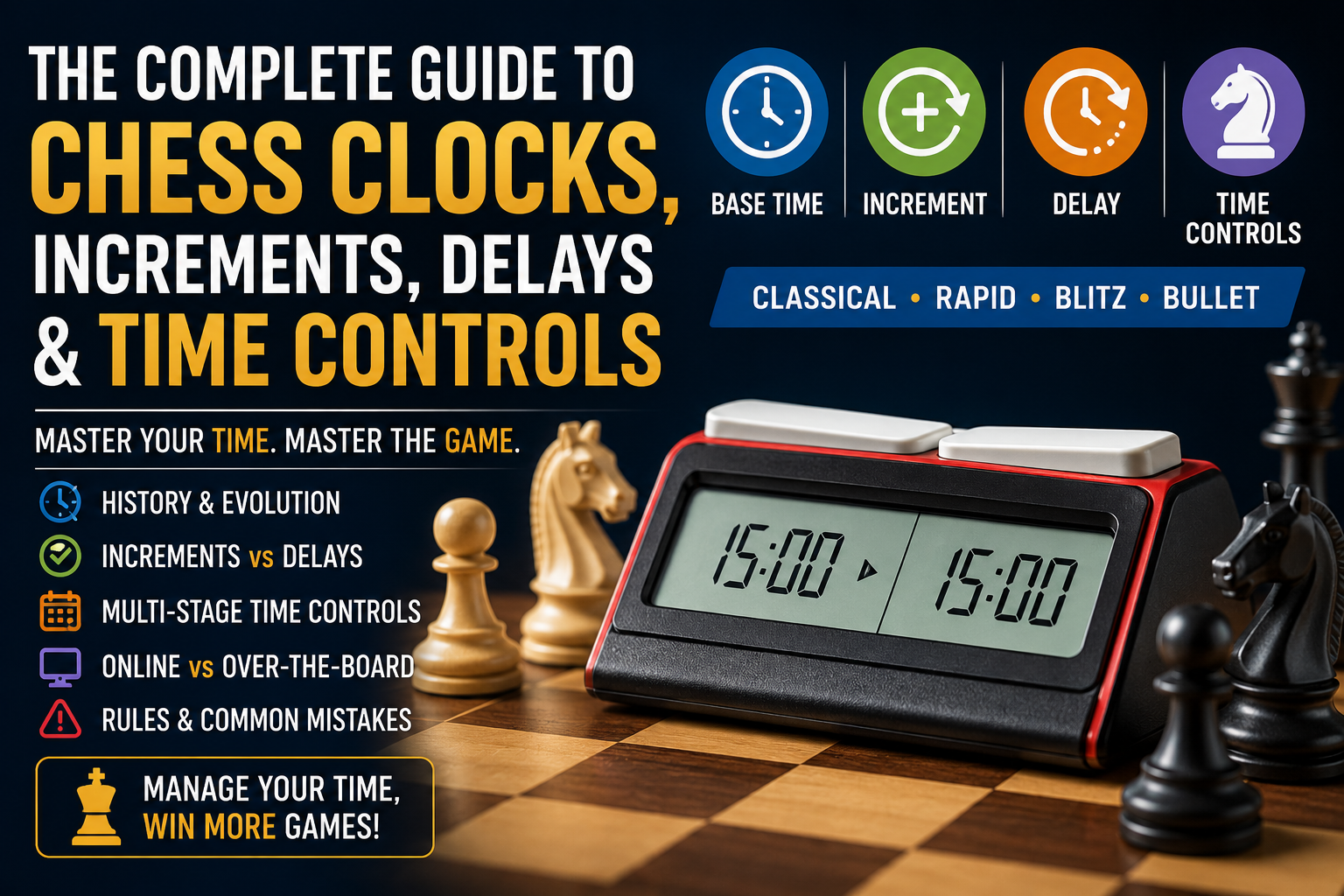
Fallen flag, increments and delays, chess clock in over the board chess and online. Today I'm covering everything about the chess clock, the tool that makes chess a sport. Welcome back to chesstimerdigital.
Before the 1880s, chess games could last forever. Players took hours per move. Some games stretched across multiple days. It was psychological warfare, exhausting your opponent through delay.
The first mechanical chess clocks appeared in the 1880s. They made competition fair and decisive. Suddenly, thinking time became a limited resource. Chess transformed from an intellectual exercise into a time sport.
Major championships, world championship, Olympiad, Candidates require FIDE compliant electronic clocks. Regular FIDE rated tournaments can use either electronic or mechanical clocks. In practice, it's become increasingly rare to see analog clocks in use in most places.
If you want to run Blitz tournaments, you need to have digital clocks. We acquired our first clocks back in 2013, and there was no doubt, digital was even then the only sensible choice.
The original mechanical clocks had two clock faces with a lever in the middle to switch between them. Each clock had a small flag mechanism that would fall when time expired. That's where the term flag fall comes from, losing on time.
We still use that phrase today in the digital era.
FIDE standards for mechanical clocks require a visible flag, silent operation so it doesn't disturb players, and a non-reflective surface. These clocks taught generations brutal time discipline. No increment, no delay, no mercy. Pure time management or you lose.
Modern digital clocks offer incredible precision. They can handle increment, delay, and even different times per side. Digital clocks actually enabled rapid and blitz chess as we know it. Analog clocks simply weren't precise enough for short games.
Most tournament chess today uses digital, but the core principles remain from the 1880s.
Base time is your starting pool of thinking time for the entire game. Like 90 in the 90 + 30 time control equals 90 minutes. That is your base time; or 10 in 10 + 0.
When your time on the clock reaches zero, game over, even if you're winning on the board.
But base time is just the starting point. Time systems add layers of complexity.
Increment is the most important clock innovation in chess history. Before increment, over 50% of decisive games ended in timeout, not checkmate. Think about that. More than half of all losses were time losses, not chess losses.
It adds seconds to your clock after each move. In a 15 plus 10 game, 10 seconds are added back every time you complete your move.
Here's the key. You can never run out of time if you keep moving.
It's also called Fischer time after Bobby Fischer who popularized it.
After increment became standard, games started being decided by chess quality, not hand speed.
FIDE standards. Today, World Classical uses 30-cond increment. Rapid uses 10 seconds. Blitz uses two seconds. Increment rewards good chess over fast reflexes.
Delay works differently from increment. It's like a grace period. Named after Grandmaster David Bronstein, who proposed it.
The clock pauses for a set time before counting down.
Here's the key difference from increment. Time never goes up, only stays the same or goes down.
Let me explain with a 5-second Bronstein delay example. If you move in 2 seconds, the clock adds those two seconds back. You stay at the same time.
If you move in 8 seconds, the clock adds 5 seconds back. You lose 3 seconds total.
The delay is applied after your move is completed. It prevents time loss for fast play, but still punishes thinking over the bonus time.
Delay versus increment. Delay favors decisive fast moves because you can't build a time bank. Increment rewards consistent play because you can build a time reserve.
Delay is rare today. Most tournaments use increment. Delay is rarely really used.
Remember from the time controls Blog I said we'd explain the weird formats. Here they are.
Multi-stage time controls like 90 + 40 + 30 work like this.
Stage one, 90 minutes for your first 40 moves.
Stage two, an additional 40 minutes are added after move 30.
Stage three, 30 second increment from move one.
The World Championship uses an even more complex version.
120 minutes for the first 40 moves, 60 minutes for the next 20 moves, then 15 minutes for the rest with 30 secondond increments starting from move 61.
Multi-stage ensures enough time for complex positions, but guarantees games eventually end.
Other variations include different time per side for handicap games, time odds where the stronger player gets less time, and sudden death formats where you must finish by a certain move or lose on time.
I have never seen those live.
Top tournaments use electronic boards that broadcast moves live worldwide. Just watch out when around those. There are usually cables that at least a few people step on or pull and mess the whole thing up.
The clock integration means the board automatically records the exact time spent on each move.
These boards must be FIDE compliant. Same rigorous testing as standalone clocks.
The benefits are significant. Accurate move timing, live broadcast capability, historical data preservation, and no manual score sheet errors.
World Championship, Candidates, Olympiad, and many other events all use electronic boards with integrated clocks. They've made chess globally accessible. Millions can watch games with exact timing data.
These violations can cost you the game.
Forgetting to press the clock after moving. I have to confess, it happens to me also.
Using the wrong hand, you must use the same hand that moved the piece. I have seen a child lose a game at the European Cadet Championship because of this.
Hovering your hand over the clock while your opponent thinks, that's intimidation and it's illegal.
Knocking pieces over, you must fix them on your own time, not your opponents.
Pressing the clock before completing your move, the move must be fully completed first.
Using both hands to make a move or press the clock, that's considered an illegal move.
These are violations of FIDE laws of chess.
The first offense typically gets a warning plus two minutes added to your opponent's clock.
Second violation, game over. You lost.
Let me clarify the official sequence for making moves.
According to FIDE laws, players must record moves throughout play.
The proper order is first make your move on the board and complete it fully. The piece must be released.
Second, press your clock with the same hand that moved the piece.
Third, record the move on your score sheet if time allows, not required when you have under 5 minutes remaining.
Important clarifications. A player may reply to the opponent's move before recording it if they wish, but must record their previous move before making another.
With electronic score sheets, you must make the move on the board before recording.
Why does other order matter? It ensures fair play and prevents disputes.
Online removes physical errors completely.
No forgetting to press the clock. It's automatic.
No wrong hand violations.
No hovering intimidation.
The clock is always accurate to the millisecond.
But online adds new factors.
Mouse speed and Wi-Fi quality become factors.
Pre-moves change time dynamics completely.
A pre-move is when you make your move during your opponent's turn that will automatically be played as soon as it's your turn.
This saves precious seconds in time in time trouble, but it's risky if your opponent plays any unexpected move.
Physical chess has its own challenges.
Nerves affect your hand in pressure situations.
The click of the clock adds psychological pressure.
I hear so often "I blundered in time trouble" as the reason for a loss.
Under 30 seconds, even strong players start making mistakes.
Under 10 seconds, panic mode for most people.
Learning to stay calm under time pressure takes years and hundreds of games.
The clock creates a second opponent.
You're fighting the position and time simultaneously.
With increment, you can take your time on critical moves and build time back with fast moves, but the pressure is there.
Now you understand how clocks work. Base time, increment, multi-stage controls.
You know the rules, how to press it, when to press it, what mistakes to avoid.
But here's the critical question every improving player faces.
Which time control should you actually play?
Bullet for speed, blitz for fun, rapid for learning, classical for tournaments.
Each format trains different skills.
The next Blog reveals which is right for your goals.
Next up, which time controls to play online.