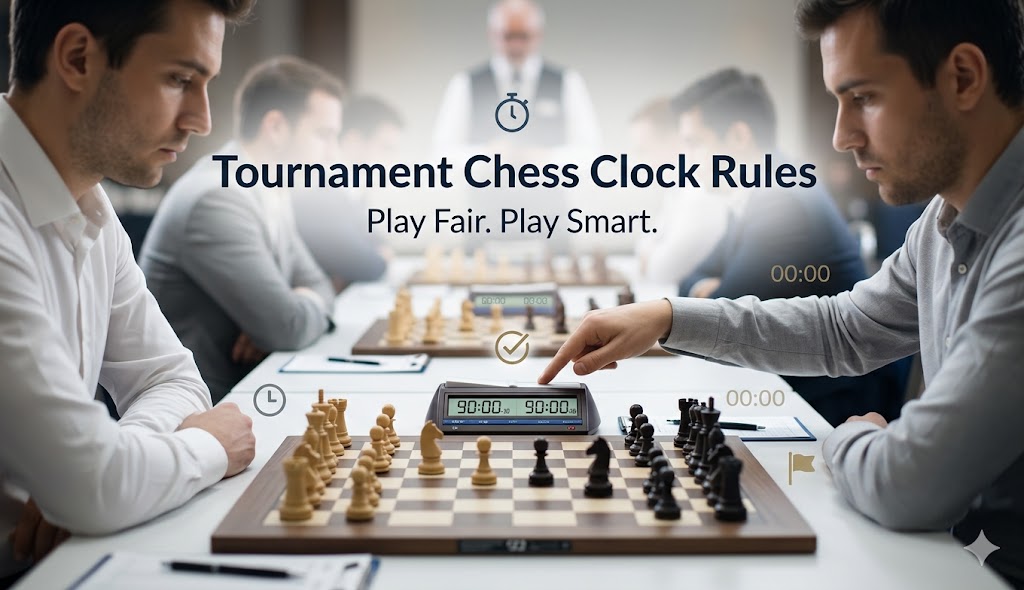
Chess tournaments require players to demonstrate precise time management skills for their games. The chess clock tournament rules maintain fair competition while they stop players from delaying matches and they ensure that match times are followed. A single flag fall will terminate your game match because it ends the game even when you have an advantage on the chessboard.
Whether you're entering your first local event or a FIDE-rated open, this guide covers all official rules from setup to disputes. At chesstimerdigital.com, we build FIDE-compliant digital clocks so you focus on chess, not clock drama.
Why Clocks Matter in Tournaments
Clocks control thinking time, forcing decisions under pressure. Without them, games could last days. Rules balance deep calculation with efficiency.
Key goals:
-
Equal time for both players.
-
No endless delays.
-
Clear win conditions (board or time).
FIDE (global) and USCF (USA) rules align closely but have nuances.
Official Time Controls by Format
Tournaments use specific controls. FIDE sets standards:
USCF variations: Often G/90 d30 (90 min + 30s delay) for classical.
Increment starts move 1 on digital clocks.
Clock Setup Rules
Article 6.5 FIDE Laws: Arbiter decides placement — usually between players, visible to both.
-
White's clock starts at round time.
-
Late players: Lose time until arrival (default 0 min, or event-set).
-
Orientation: Black chooses side if applicable.
Approved clocks: FIDE-rated digital (DGT standard). Analog OK for casual.
Pressing the Clock: Strict Rules
FIDE 6.2.1:
-
Same hand rule: Move pieces with right/left hand → press clock with same hand.
-
No hovering: Finger off button until move complete.
-
Full press: Clock must click/stop fully.
Penalty: Illegal move + time adjustment (arbiter discretion).
Touching opponent's clock: Instant penalty (2 min added to opponent).
Flag Fall: What Happens When Time Runs Out
FIDE rule: Flag fall = loss on time, unless:
-
Checkmate/stalemate first.
-
Both flags fall simultaneously → draw.
-
Dead position (insufficient material).
Verification: Opponent stops both clocks. Arbiter confirms.
Digital flags: Automatic beep/00:00. Analog: physical drop.
Handling Irregularities and Disputes
Clock malfunction (6.10):
-
Stop both clocks.
-
Arbiter resets to correct settings.
-
Adjust times/move count by "best judgement".
Wrong settings discovered mid-game: Restore position, adjust clocks (6.13).
Illegal move + clock press: Piece replacement + 2 min penalty (first offense).
Pairing disputes: Clocks run from round start — late forfeit possible.
Default Time and Late Arrivals
FIDE 6.7: Default = 0 min (arrive after start = forfeit).
-
Events can set 30–60 min.
-
Absent both? White loses elapsed time first.
Practical: Arrive 15 min early. Clocks start precisely.
Special Tournament Situations
Increments and Delays
-
Fischer increment: Preferred FIDE (adds after move).
-
Bronstein/USCF delay: 30s standard for some events.
-
Must match tournament announcement.
Adjourned Games (Rare)
-
Old rule: Seal move, resume later with clocks.
-
Digital era: Almost obsolete.
Online Tournaments
-
Arena software enforces.
-
Same FIDE rules apply.
Team Events
-
Board 1 classical, lower boards rapid.
Step-by-Step: Your Tournament Clock Checklist
-
Arrive early: Check clock type (digital/analog).
-
Verify settings: Ask arbiter (e.g., 90|30).
-
Position pieces: Correct setup before start.
-
White starts: Arbiter or Black presses your clock.
-
Press properly: Same hand, full stop.
-
Monitor both flags: Yours + opponent's.
-
Time trouble? Signal arbiter if needed.
-
Endgame: Confirm win before celebrating.
Pro tip: Practice with our FIDE-clocks at home.
Penalties for Clock Violations
Arbiter has final say.
Digital vs Analog in Tournaments
Digital advantages:
-
Precise increments.
-
Auto flags.
-
Move counters.
-
FIDE mandatory for rated events.
Analog allowed but fading: Flags debatable.
Recommendation: Buy FIDE-approved digital.
Preparing for Your First Tournament
-
Study FIDE Laws Article 6 (free PDF).
-
Practice 90|30 on chesstimerdigital.com clocks.
-
Simulate penalties in training.
-
Pair with scorebook (required).
Mental prep: Time management > deep calc in pressure.
Common Beginner Mistakes
-
Forgetting same-hand rule.
-
Pressing too lightly (digital doesn't register).
-
Ignoring opponent time.
-
Panicking at 5:00 (budget ahead).
Conclusion: Master the Clock, Master the Game
Chess clock tournament rules are simple but strict. Proper setup, same-hand presses, flag vigilance, and arbiter respect keep you penalty-free. FIDE's system — from 90|30 classical to 5|3 blitz — ensures global fairness.
Enter your next event confident. A great clock is your edge.