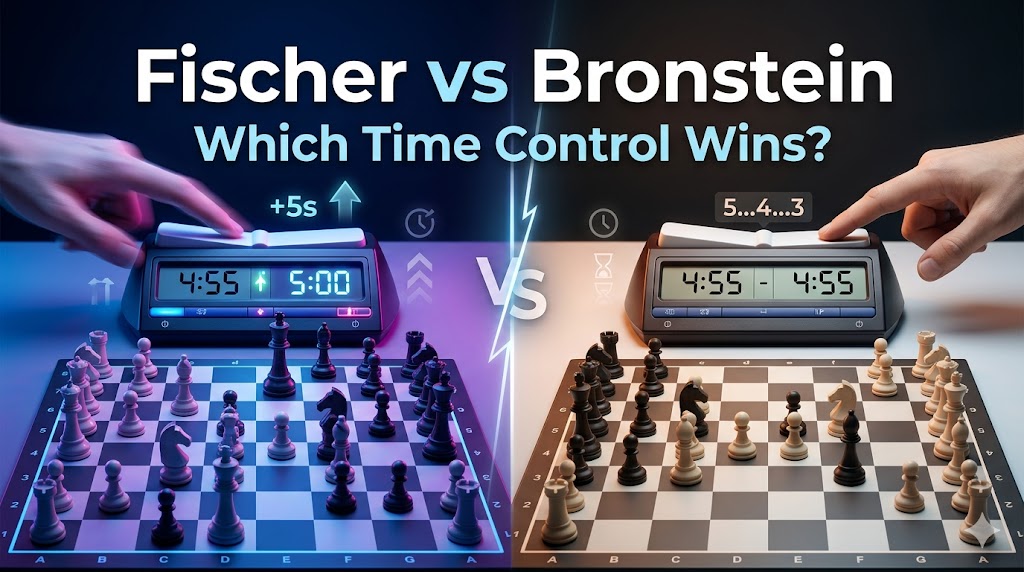
When setting up your chess clock, you face a choice: Fischer increment or Bronstein delay? Both fix old clock problems like unfair flagging, but they work differently. The Fischer vs Bronstein chess clock debate comes down to your game style, tournament rules, and how you handle time pressure.
At chesstimerdigital.com, every digital clock supports both modes. Fischer suits online blitz. Bronstein fits steady tournaments. This comparison — with examples, tables, and tips — helps you decide.
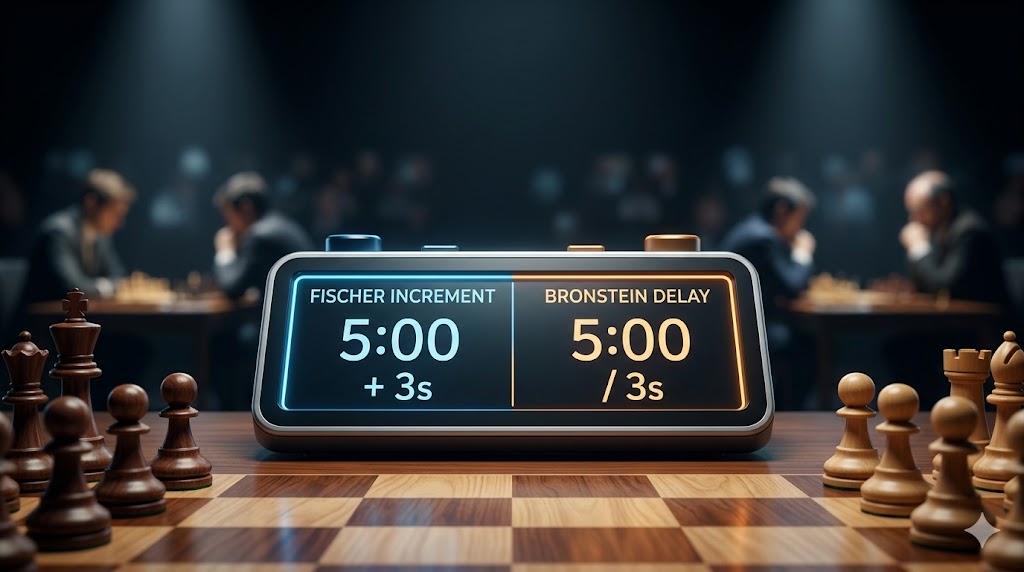
A digital chess clock mid-game, perfect for switching between Fischer and Bronstein modes seamlessly.
Quick Definitions
Fischer Increment (Bobby Fischer, 1988): Adds fixed seconds after every move. Your clock can grow if you move fast. Example: 10|5 = 10 minutes + 5 seconds per move.
Bronstein Delay (David Bronstein, 1970s): Gives up to X seconds per move. Only used time is credited back; no growth beyond your turn-start time. Example: 10|5 = 10 minutes with 5-second delay .
Both prevent instant losses but reward play differently.
How Each Mode Works: Step-by-Step
Fischer Increment Example (5|5 Game)
-
Turn starts: 4:55 left.
-
Think 2 seconds → Move → Press → +5s → Now 5:00.
-
Next turn: Think 8 seconds → Press → Net -3s → 4:57.
-
Result: Fast play builds time. Slow play erodes it gradually.
Clock can exceed start time after many quick moves.
Bronstein Delay Example (Same 5|5 Setup)
-
Turn starts: 4:55.
-
Think 2 seconds → Move → Press → Credits back 2s → Still 4:55.
-
Next: Think 8 seconds → Press → Credits 5s (max) → Now 4:52.
-
Result: Always at least 5s buffer. No building time.
Stable display — mentally reassuring.
Detailed Comparison Table
Fischer = flexible bank. Bronstein = consistent shield.
Real-World Examples: 10|5 in Blitz
Scenario: Move 35, you're low on time.
Fischer:
-
1:12 left → Think 4s → +5s → 1:13.
-
Next 3 quick moves → 1:21.
-
Outcome: You banked 9 seconds. Endgame tactic wins.
Bronstein:
-
1:12 → Think 4s → Back to 1:12.
-
Slow think 7s → 1:10 (2s lost).
-
Outcome: Steady at ~1:08. Technical draw possible.
Fischer saves desperate positions. Bronstein prevents panic altogether.
History: Fischer vs Bronstein Rivalry
Both Grandmasters fixed 1970s clock flaws — stalling and flag rushes.
-
Bronstein (earlier): Focused on per-move fairness without endless games. Popular in US clubs.
-
Fischer (1988): Patented accumulating time for dynamic play. FIDE adopted it globally.
Fischer wanted "chess over clock." Bronstein wanted "no clock tricks."
Pros and Cons
Fischer Pros/Cons
Pros:
-
Builds time buffer for complex positions.
-
Forgiving for thinkers.
-
Standard online/FIDE.
Cons:
-
Clock balloons → overconfidence.
-
Blitz speed-chess endings possible.
-
Harder for strict tournaments.
Bronstein Pros/Cons
Pros:
-
Predictable — no surprises.
-
Enforces discipline.
-
USCF/tournament favorite.
Cons:
-
No recovery from early time loss.
-
Feels restrictive in endgames.
-
Less common online.
Tournament Rules: FIDE vs USCF
-
FIDE (Global): Fischer dominant (90 minutes + 30s/move). Bronstein rare.
-
USCF (USA): Prefers delay (Bronstein/simple). 30s delay standard for quick events.
Online: Fischer everywhere (10|5, 15|10). Lichess/Chess.com default.
Know your league!
Which Should You Use? Recommendations
Choose Fischer if:
-
Online blitz/rapid player.
-
Like building time cushions.
-
FIDE events or global tourneys.
-
Beginner — forgiving recovery.
Choose Bronstein if:
-
USCF/club tournaments.
-
Prefer steady, no-drama pace.
-
Teach kids — teaches management.
-
Classical where consistency wins.
Hybrid tip: Practice both. Our clocks switch modes instantly.
By format:
Setting Up on Digital Clocks
Easy steps (DGT/our models):
-
Menu → Time Control.
-
Base time → Mode (Fischer/Bronstein).
-
Set increment/delay (5s).
-
Preset save.
Pro hack: Label presets: "Blitz Fischer 5|5" vs "Rapid Bronstein 15|5."
Player Psychology and Strategy
Fischer mindset: "Bank time now, calculate later." Rewards aggression.
Bronstein mindset: "Stay even, no peaks/valleys." Rewards patience.
Adapt: Fischer players blitz better. Bronstein players handle pressure evenly.
Final Verdict: No One-Size-Fits-All
Fischer vs Bronstein chess clock? Fischer for modern, flexible play (90% of users). Bronstein for disciplined tournaments.
Most players default Fischer online, learn Bronstein for events. Test both — your style decides.