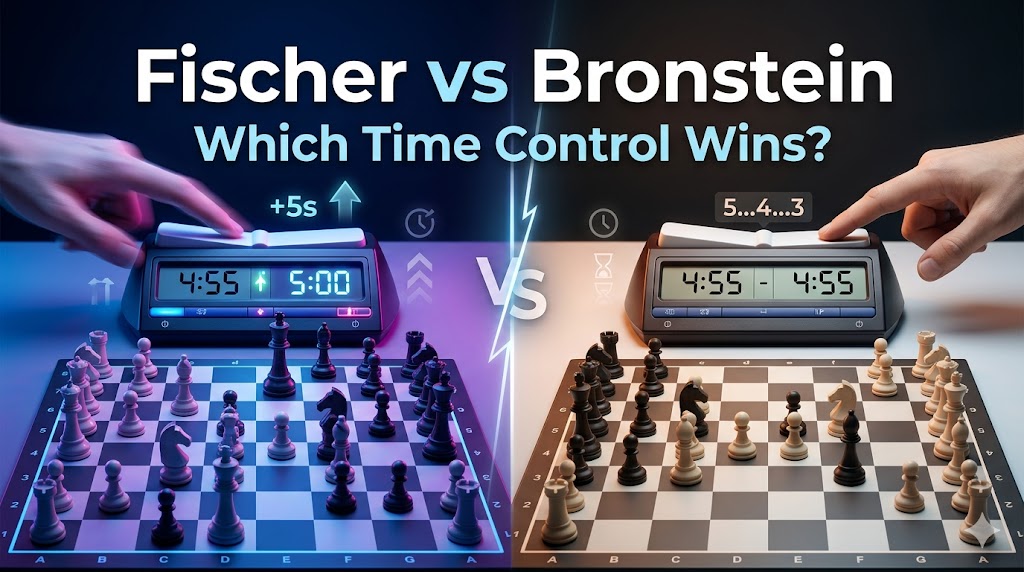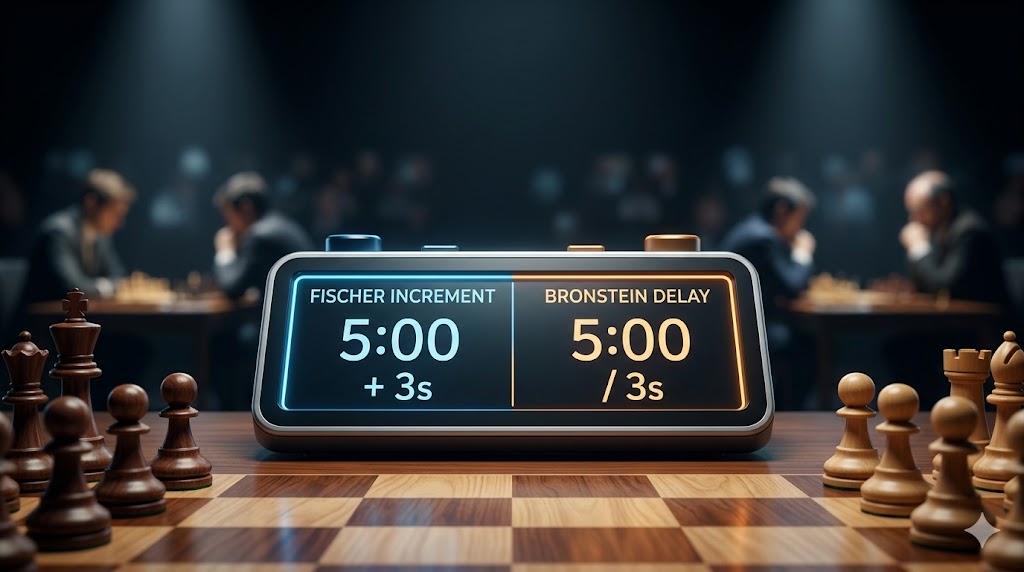
One of the largest questions with digital chess clock the first time you use it is: Is Fischer increment better or Bronstein delay? Both systems intend to safeguard the players against pure time scrambles but they experience very different in real games.
This guide will deconstruct the concept of Fischer vs Bronstein time control in easy-to-understand language, demonstrate precisely how the clock works with each of the systems, and offer a discussion on why each of them makes the most sense as applied by a beginner, club player, and serious tournament competitor.
What Is Fischer Time Control?
Increment (also known as Fischer time) was the buzzword of former World Champion Bobby Fischer.
-
The players will be allocated a fixed amount of time, say 5 minutes or 90 minutes.
-
There is a set amount of time added to your clock after each move like 2 or 3 seconds. This increment you get, on each of your moves, however long you may think.
-
Your total time can improve upon your initial time in theory, since you can complete the game with more time than you began with, should you increase faster than the increase.
Example (5+3 blitz):
-
You start your move with 5:03 on the clock.
-
You think for 2 seconds; the clock drops to 5:01.
-
After you press the button, 3 seconds are added and your time becomes 5:04 — you gained 1 second overall.
That is why Fischer increment is considered a cumulative, time‑gaining system.
What Is Bronstein Time Control?
Bronstein time is often grouped with “delay mode”, but its implementation is slightly different from pure simple delay.
Key ideas:
-
Each move comes with a fixed extra allowance (for example 3 or 5 seconds), but unused extra time does not accumulate.
-
The clock never goes above the time you had when you started the move. You can keep your initial time from the beginning or you can lose time but you will never achieve additional time.
-
If you take longer than the delay (say a 5‑second delay and you think for 7 seconds), the excess time is deducted from your main time, just like a normal clock.
Example (5 minutes + 3 seconds Bronstein):
-
You start the move at 5:03.
-
The time will decrease to 5:01 after you take 2 seconds to complete your move. The clock shows 5:03 time when you press the button because both time loss and time gain have been prevented for you.
-
The clock will start at 4:58 after you use 5 seconds but it will return to 5:01 after you complete your move like Fischer. The time will never go beyond the initial 5:03 limit.
Because of this, Bronstein is often called non‑accumulating increment.
Simple Delay vs Bronstein vs Fischer (At a Glance)
Many digital clocks support three related modes: Simple Delay, Bronstein, and Fischer.
Practical Differences Over the Board
1. Time Psychology
-
With Fischer increment you know you will always receive a bonus after each move, which makes it easier to defend difficult endgames without instantly losing on time.
-
With Bronstein, the clock never climbs above your move‑start time, so mentally it feels like there is a hard ceiling — you can save time but never build a bigger bank.
Some players feel Fischer increment makes flagging (winning purely on time) easier, since you can rapidly play simple moves to grow your clock while your opponent burns time.
2. Move Quality and “Farming Time”
Many strong players argue that Fischer increment sometimes encourages “cheap” quick moves made mainly to harvest time rather than find the best move.
In Bronstein mode there is no reward for ultra‑fast moves; the best you can do is keep your time steady. In theory this nudges players to focus more on move quality than on time farming.
Official Rules and Tournament Usage
-
FIDE uses Fischer increments in most of its classical and rapid formats, such as 90+30 or 120+30.
-
US Chess (USCF) traditionally prefers delay systems and defines Bronstein‑style non‑accumulating delay in its rulebook.
So if you play FIDE‑rated events, being comfortable with Fischer increment is essential, while many US club events still rely heavily on Bronstein or simple delay.
Which Time Control Is Better for Whom?
Beginners
-
New players should focus on winning or losing their matches based on their current position instead of using the game clock for their evaluation.
-
The Fischer increment system which uses 15+10 and 10+5 time controls, provides each player with a basic security measure, which decreases the occurrence of players losing their games because of time expiration.
Fischer increment system provides beginners with clock management training because it creates a more relaxed environment for playing under modest time limits.
Club Players
-
In many club and local tournaments you will see Bronstein or US‑style delay.
-
It is useful to practice both systems:
-
Training games: 10+5 or 15+10 Fischer (online or with a physical clock)
-
Club practice: 25 minutes with 5‑second delay or Bronstein mode
-
Bronstein helps you develop stricter time discipline because you know the clock will never rise above your current level.
Advanced / Tournament Players
For advanced players, the key question is: Which federation and events do you mostly play?
-
International opens, norm events, FIDE‑rated tournaments → mastering Fischer increment is non‑negotiable.
-
USCF circuit, weekend Swisses, scholastic events → understanding delay/Bronstein behaviour is critical.
Strong players also adapt their opening preparation to the time system: they blitz out well‑known theory, build a time reserve with increment, and invest that saved time in complex middlegames and technical endgames.
Concrete Over‑the‑Board Examples
Imagine a time control of “5 minutes + 3 seconds” and you must survive four tricky moves in a row.
-
Fischer increment:
-
If you play each move in 1–2 seconds, the 3‑second increment per move can actually increase your clock above the original starting time.
-
Result: you can escape trouble and come out with 20–30 extra seconds compared to where you started.
-
-
Bronstein delay:
-
With the same move speed, your time after each move returns to the move‑start level at best — you simply avoid losing time, but never gain any.
-
Result: you stabilize your clock instead of building a larger time cushion.
-
This subtle difference can be decisive in sharp endgames.
Fischer vs Bronstein: Which Should You Choose?
From a practical point of view:
-
Online chess platforms which include Chess.com and Lichess have established Fischer-style increments as their standard time control system.
-
The 10+5 and 15+10 Fischer controls provide OTB beginners and casual club players with an optimal combination of move quality and time safety.
-
US club and scholastic events: learning Bronstein or simple delay is important because many tournaments still use them.
Practical recommendation:
-
If your main focus is online chess and FIDE‑rated events → treat Fischer increment as your primary system and learn Bronstein as a secondary skill.
-
If you mostly play USCF or local delay‑based tournaments → focus on Bronstein/simple delay first, but stay comfortable with increment for online training.
Training Tips: Get Strong With Both Systems
-
On some days, play 15+10 or 10+5 Fischer practice games (online or with a physical clock).
-
Players must select between 25+5 Bronstein or 5‑second delay when they practice training games or solve puzzles on different days.
-
A player should establish a basic pattern which includes avoiding time waste during openings and dedicating full cognitive resources to essential middlegame and endgame situations while maintaining continuous movement and button pressing with mental processing in a rhythmic pattern.
No time control exists which provides perfect conditions, but your winning streaks will stop declining when you establish proper habits and choose the appropriate time control for your surroundings.
Conclusion
Fischer and Bronstein share the same basic goal: to keep games fair and to reduce random flagging, while still rewarding good time management.
-
Fischer increment lets you build up time and has become the standard in modern FIDE and online chess.
-
Bronstein delay keeps a hard cap on your time and teaches disciplined, position‑first thinking, which is very popular in US‑style tournaments.
In the end, the “best” system is the one that matches your tournament environment and personal comfort — but for any serious chess player, understanding and confidently using both Fischer and Bronstein time controls is a must‑have skill.