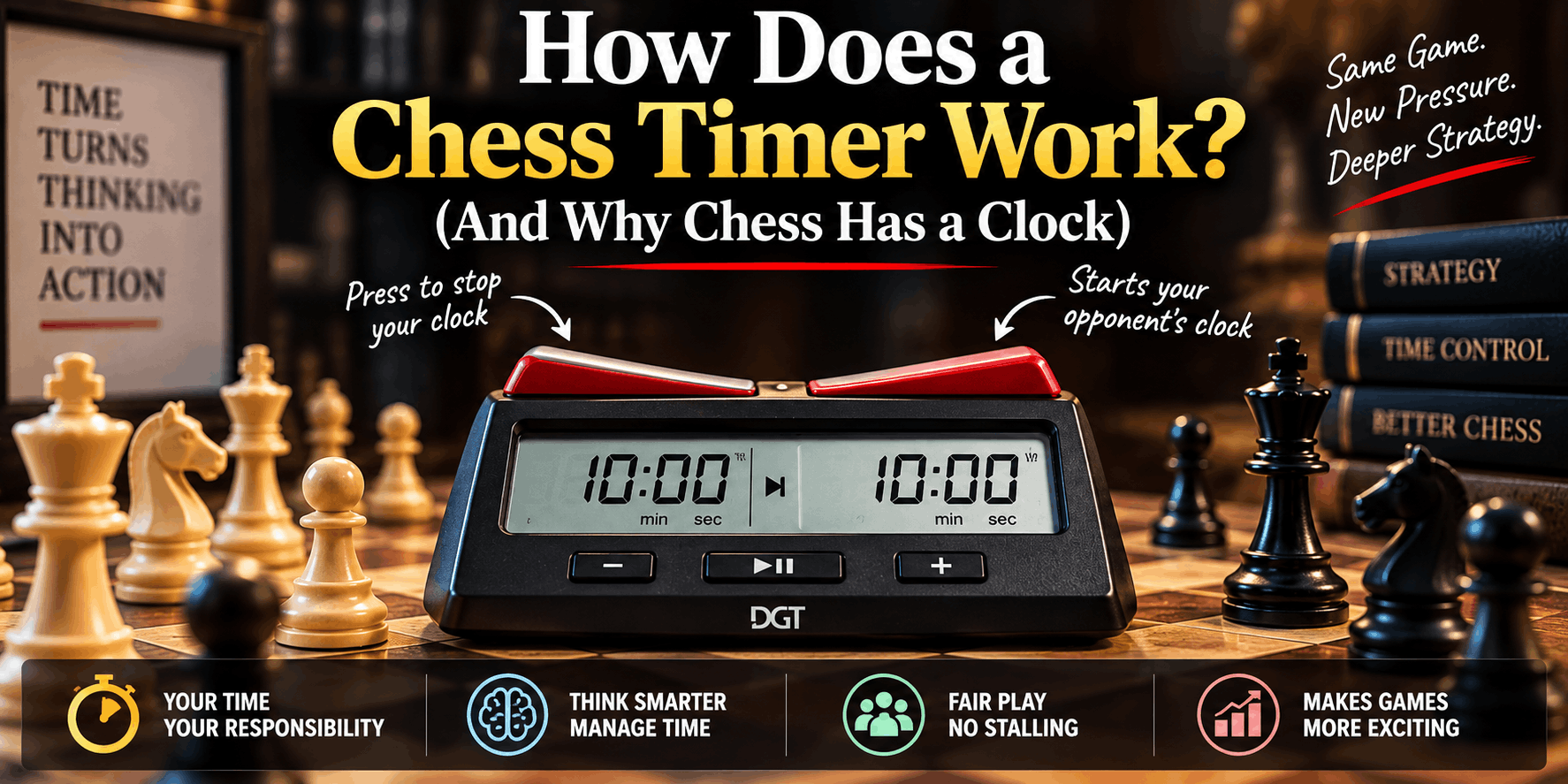
A chess timer is two clocks in one body, and only one of them ever runs. When you finish your move, you press your button. That stops your clock and starts your opponent's. They move, they press, control comes back to you. That back-and-forth continues until someone checkmates, someone resigns, or someone's time hits zero.
That's the whole mechanism. Everything else, the increments, the flags, the blitz formats, sits on top of that single idea.
What the timer is actually for in chess
The clock does not measure the game. It measures you.
Each player gets a private budget. Spend twelve minutes calculating one sharp knight sacrifice, and that twelve minutes comes out of your pocket alone. Your opponent's budget doesn't move. So every long think has a real price, and you're constantly deciding whether the position is worth paying for.
Three things come out of that:
- Games end. A tournament can actually schedule rounds instead of hoping players finish.
- Stalling stops being a strategy. You can't sit on a losing position and wait for your opponent to get bored.
- Time becomes a resource you can win with. Two players, equal material, one has 40 seconds and the other has 9 minutes. That's not an equal position anymore.
Strong players attack the clock the way they attack a weak pawn. They'll steer into messy, calculation-heavy positions when they know the opponent is low on time, because a rushed move is usually a bad move.
Why there's a timer in chess at all
Chess had no clock for most of its life, and the results were miserable.
At the London 1851 tournament, Howard Staunton complained bitterly about Elijah Williams, who would sit for well over an hour on a single move. Games dragged past ten hours. Players lost on exhaustion rather than on the board, and spectators simply walked out.
The first fix was crude. In the 1861 Anderssen–Kolisch match, each player got a sandglass, and you flipped yours when you moved. Sand leaks, glasses break, arguments follow.
The real breakthrough came in 1883, when Thomas Bright Wilson of the Manchester Chess Club built a pendulum-based double clock for the London tournament. Two mechanisms on a seesaw. Tilt one down, the other goes up. That design is the direct ancestor of every chess clock sitting on a tournament table today.
Then Bobby Fischer patented a digital clock in 1988 that added a few seconds back after every move. That one idea changed how modern chess feels, and I'll get to why in a moment.
How a chess timer works, step by step
Here's the actual sequence in a real game:
- Black usually gets to choose which side of the board the clock sits on, so it's within easy reach.
- Both clocks show the full starting time. Nothing is running.
- The arbiter (or Black) starts White's clock. White is on the move, so White is on the meter.
- White plays a move on the board, then presses the button with the same hand that moved the piece.
- White's clock freezes. Black's clock begins counting down.
- Repeat until the game ends.
That fourth point catches people out constantly. Move first, press second. One hand for both. Press with your left while your right is still hovering over a bishop, and in a rated game your opponent can call the arbiter.
On an analog clock: the flag
Old mechanical clocks have a small hinged flag above the 12. As the minute hand climbs toward the hour, it lifts the flag. The instant the hand passes 12, the flag drops.
That falling flag is the visual proof that your time expired, and it's why chess players say "I got flagged" or "I won on the flag." Nobody says "my time allocation elapsed."
One catch worth knowing: with an analog clock, the flag has to be noticed and claimed. If neither player sees it and the game plays on, the moment can pass.
On a digital clock: the display
Digital clocks removed the guesswork. You see the exact seconds, the display often shows which player is on the move, and once a clock hits 0:00 it announces it. No claim needed, no squinting at a tiny piece of metal.
Digital clocks also unlocked something analog physically could not do: giving time back.
Increment and delay (the part most beginners skip)
This is where the same "10 minutes" can mean two very different games.
Increment (Fischer): A set number of seconds is added to your clock every time you make a move. In a 3+2 setup, you begin with 3 minutes. Then you gain 2 more seconds after each move you play. Play fast enough and your clock can actually go up. Unused increment stays banked.
Delay (simple or Bronstein): the clock pauses for a few seconds before it starts draining. With a 5-second delay, a move made in 3 seconds costs you nothing, but you can't hoard the leftover 2 seconds. Nothing accumulates.
The practical difference:
| Increment | Delay | |
|---|---|---|
| Time can grow | Yes | No |
| Unused seconds saved | Yes | No |
| Common in | FIDE and online play | US club and scholastic play |
Why it matters: in a pure 5+0 game, a won endgame can be lost purely because you physically cannot move the pieces fast enough. Add a 3-second increment and that same endgame is playable. If you're setting up a game for beginners, an increment is the single kindest setting you can choose.
Standard time controls at a glance
- Bullet: 1+0, 2+1. Pure reflex. Blunders are constant and forgiven.
- Blitz: 3+2, 5+0. Pattern recognition beats calculation here.
- Rapid: 10+0, 15+10. Enough room for a real plan without burning an afternoon.
- Classical: FIDE standard is 90 minutes for the first 40 moves, then 30 more minutes, with 30 seconds added from move one.
Starting out? Play 10+5 or 15+10. Bullet feels exciting and teaches you almost nothing, because you never get to finish a thought.
What happens when your time runs out
Normally you lose immediately, no matter how winning your position was. A full queen up means nothing against a fallen flag.
But there's an exception a lot of club players have never read. Under FIDE rules, if your time runs out and your opponent cannot possibly checkmate you with the material they have left, the game is a draw, not a loss. Lone king against your lone king, or a king and a single bishop with no forced mate available, and you escape with half a point.
Worth memorizing. It has rescued more desperate endgames than any tactic.
Clock mistakes that cost real games
- Forgetting to press. Your clock quietly drains while you admire your own move. This is the most common way amateurs lose on time.
- Pressing before moving. Illegal, and it hands your opponent a free complaint.
- Two-handed pressing. Move with one hand, press with the same one.
- Blitzing out your opening. People save six minutes in a position they know by heart, then still panic on move 30. Time saved early is only useful if you actually spend it on the critical moment.
- Ignoring the opponent's clock. Their remaining time should shape your choices. If they have 25 seconds, keep the position complicated.
How to get better at using the clock
Try this over your next ten games:
- Set a rough budget before you start. In a 15-minute game, aim to reach move 20 with at least 7 minutes left.
- Find the one critical position. Most games have a single moment where the structure changes. That's where your long think belongs, not on move 6.
- Play the obvious move fast. Recapture, defend, castle. If there's only one reasonable option, don't audit it for two minutes.
- Check both clocks every five moves. Make it a habit, not a panic reaction.
- Review your losses for time, not just tactics. Where did the clock actually break? Usually it's earlier than you think.
A training clock does more than you might think, even if you just play at home. Put it on the table, hit it after each move, and the stress from the clock does not feel like panic anymore. It turns into a normal part of the game.
FAQ
Do I need a chess timer to play chess?
No. Casual games have no clock at all. You need one for tournaments, for club play, and any time you want the game to actually finish.
Which side does the clock go on?
Black generally chooses, unless an arbiter decides otherwise. Most players put it on their right.
Can I use my phone as a chess timer?
Yes for casual and home play. Most rated over-the-board tournaments require a dedicated clock, since phones are usually banned from the playing hall anyway.
What does "flagging" mean?
Winning because your opponent's time hit zero. The word comes from the little flag on old analog clocks that drops when the minute hand passes 12.
Does the clock run during your opponent's think?
No. Only one clock moves at a time, and it's always the clock of whoever is on the move.