One minute. That's it. One minute to open, develop, attack, defend, and mate your opponent before the clock runs out.
Welcome to bullet.
You've seen it before and you know what it feels like... if you've ever accidentally pressed the wrong button on Chess.com and ended up in a 1+0 game with a guy with a lightning bolt, you will know exactly what it feels like. Your pulse continues to rise. You can't remember any of your openings. Forty seconds later, you see a 'You lost on time' message and ask yourself what just happened?
Let's fix that.
What does it Mean to be Bullet Chess?
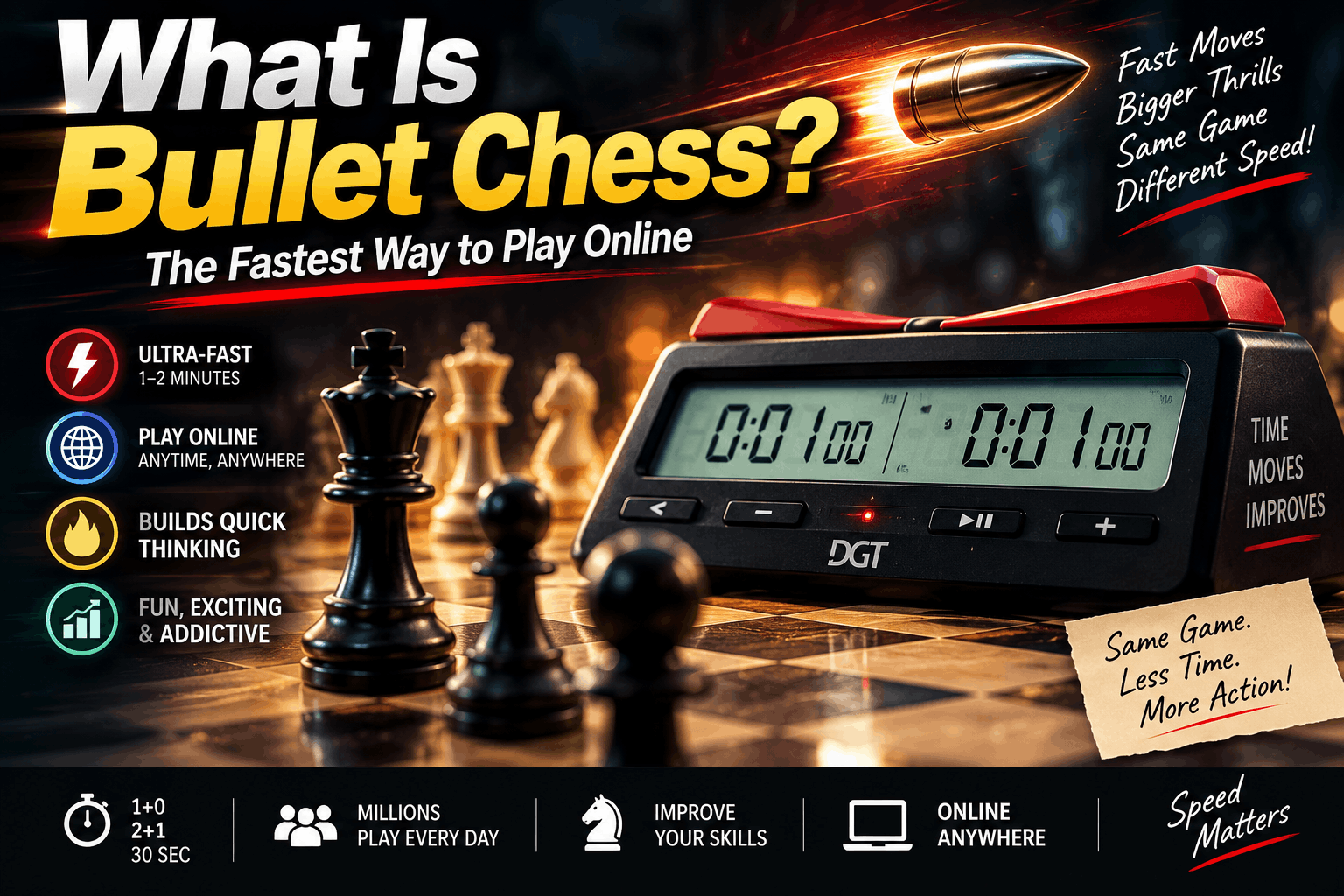
All games in which one or more player has less than 3 minutes for the entire game. That's what it's all about. Both Chess.com and Lichess draw the line at exactly the same place.
The formats you'll actually run into:
- 1+0 — one minute each, no increment. This is the bullet time control. When someone says "let's play bullet," they mean this.
- 2+1 — two minutes with a one-second increment. Slightly more civilised.
- 1+1 — a minute plus one second per move. Popular with people who hate flagging.
- Hyperbullet (30 seconds) — yes, thirty seconds for a whole game.
- Ultrabullet (15 seconds) — I have no idea how anyone does this. But they do.
Do the maths on 1+0 and the format explains itself. A normal game runs around 40 moves. That leaves you roughly 1.5 seconds per move. You are not calculating variations in 1.5 seconds. Nobody is. Not Carlsen, not Nakamura, not the engine-strength streamer who just beat you.
Why It Only Exists Online
Try playing bullet at a physical board sometime. You'll knock the king over reaching for a rook, your opponent will claim you touched a bishop, and the clock will get slapped so hard the whole table shakes.
Over-the-board bullet is chaos. Pieces fall, arbiters argue, nothing resolves cleanly.
Online, all of that disappears. The server handles legality, the clock is exact to the millisecond, and there's no physical board to spill. Which is why bullet grew up entirely inside chess websites and barely exists anywhere else.
And it grew big. Chess.com has reported somewhere around 2.5 million bullet games played every single day, making it the second most-played time control on the site, sitting just behind blitz.
The Premove: Bullet's Single Most Important Feature
Here's the thing beginners miss, and it costs them hundreds of rating points.
A premove lets you queue your next move before your opponent has even played theirs. The server executes it instantly the moment their move lands. Zero time comes off your clock. Zero.
In a format where you have 1.5 seconds per move, a move that costs you nothing is basically free money.
When to premove:
- Forced recaptures. If they take your knight and you must take back, queue it.
- Known opening sequences. Your first four or five moves in a system you play constantly.
- Forced mating nets. You've calculated it, now just fire it off.
- Endgame king marches where there's only one sensible square.
When premoving will destroy you:
- Any position where your opponent has more than one capture available
- Anything involving a check you haven't accounted for
- Complicated middlegames with hanging pieces everywhere
A premove is blind. It doesn't care that your opponent just played a queen fork. It executes anyway. I've watched strong players lose completely winning positions because they premoved a pawn push into a discovered attack.
Use it constantly. Just know when to stop.
Flagging, and the Ethics Argument Nobody Wins
"Flagging" means winning on time. In bullet, it's not a side effect. It's half the game.
You'll hear the term dirty flagging: shuffling a king back and forth in a totally lost position, hoping your opponent's clock hits zero first. Some players think this is disgraceful. Others think complaining about it in a no-increment format is like complaining about tackling in football.
My honest take? If the format awards the win on time, playing for time is playing the format. If it bothers you, switch to 2+1 and the whole problem mostly evaporates.
What genuinely is bad sportsmanship is the person who plays on with king versus queen, rook and two bishops for ninety seconds of a two-minute game. Nobody enjoys that. Not even them.
What Skills Does Bullet Actually Train?
This is where the debate gets interesting, because bullet is simultaneously overrated and underrated depending on who's shouting.
What it genuinely improves:
- Pattern recognition. You see so many positions per hour that common structures burn themselves into memory.
- Speed of recall. Your opening lines become automatic rather than reconstructed.
- Practical decisiveness. You stop dithering between two reasonable moves.
- Tactical spotting. Forks, pins and back-rank ideas get faster to see.
What it absolutely does not improve:
- Deep calculation. You have no time to calculate anything longer than two moves.
- Endgame technique. Most bullet endgames end on the clock, not on the board.
- Positional understanding. There's no time to think about pawn structure.
- Patience. Actively erodes it, in fact.
So the honest verdict is: bullet is a maintenance tool, not a growth tool. It keeps your existing knowledge sharp and accessible. It doesn't add new knowledge.
If a student tells me they play six hours of bullet daily and their rapid rating hasn't moved in a year, I'm not surprised. They've been doing reps at a weight they already lifted comfortably.
How to Actually Get Better at Bullet
Right. Practical stuff.
1. Reduce your opening repertoire to almost nothing. In classical you want breadth. In bullet you want one system you can play on autopilot against everything. The London, the King's Indian Attack, the Colle. Openings that produce the same piece placement regardless of what your opponent does.
2. Fix your mouse setup before you fix your chess. Drag-and-drop is slower than click-click for most players. Turn off piece animation entirely. Turn off move confirmation. Those milliseconds compound across 40 moves.
3. Play for complications, not for accuracy. A slightly worse position that's hard to navigate beats an equal position that's easy. Your opponent has 1.5 seconds too. Make them use it.
4. Never resign. Seriously. In bullet, a lost position is worth roughly half a point because clocks are unpredictable. Resigning in bullet is throwing away free rating.
5. Watch your own losses in slow motion. Not with an engine. Just watch where your clock drained. You'll find you spend eight seconds on one move somewhere in every game, and that move is almost never important.
6. Learn two or three cheap traps. In a format built on reflexes, a trap that wins a piece by move eight is worth more than any amount of theory.
Bullet vs Blitz vs Rapid: Which Should You Play?
| Format | Time | Best for | Plays per hour |
|---|---|---|---|
| Bullet | Under 3 min | Pattern reps, fun, openings drill | 20 to 30 |
| Blitz | 3 to 10 min | Practical play, tactics under pressure | 6 to 12 |
| Rapid | 10+ min | Actual improvement, real calculation | 2 to 4 |
Here's the split I recommend to improving players: rapid for learning, blitz for testing, bullet for entertainment. If bullet makes up more than a quarter of your total games and you want to get stronger, you have a diet problem, not a talent problem.
If you are playing chess just for the fun of it, not to win some big title, then choose what feels right to you. Chess can simply stay a game. It does not have to turn into a goal you must chase.
The People Who Are Frighteningly Good at This
Bullet has its own hierarchy, which is not the classical one.
Under the Penguig name GM Andrew Tang has established his reputation almost exclusively on ultra fast formats, playing 15 and 30 second games at a speed that would appear to be physically unsustainable. He has won several Hyperbullet Championships at Chess.com, including a few finals against Daniel Naroditsky.
As expected, Magnus Carlsen's Lichess ratings have absurd bullet ratings, with his peak being over 3300. Bullet was a key player in Hikaru Nakamura's streaming career. Hyperbullet with Nihal Sarin is just like a hyperbullet with most people.
Watch any of them for twenty minutes. You'll learn more about clock handling than from any article, including this one.
Frequently Asked Questions
What is bullet chess in simple terms? Any online chess game where each player has less than three minutes total. The most common version is 1+0, meaning one minute each with no extra time added per move.
Is bullet chess bad for your chess? It won't ruin you, but it won't improve you much either. Bullet sharpens patterns you already know. It doesn't build calculation, endgame skill, or positional judgement.
What's the difference between bullet and blitz? Bullet is under 3 minutes per player. Blitz runs from 3 to 10 minutes. The gap sounds small but blitz gives you enough time to actually think, which changes the game completely.
Can you play bullet chess over the board? Technically yes, practically no. Pieces get knocked over, illegal moves are disputed, and there's no premove function. It's an online format for a reason.
Is bullet chess rated by FIDE? No. FIDE rates classical, rapid and blitz. Bullet and hyperbullet only exist on online platforms and only carry online ratings.
What's the fastest chess time control? Ultrabullet, at 15 seconds per player for an entire game. At that speed the result depends more on mouse speed and premove chains than on chess understanding.
Next up: if you're moving from online speed chess toward real tournaments, you'll need to understand the equipment and the rules. Now go lose fifty bullet games. It's how everyone starts.