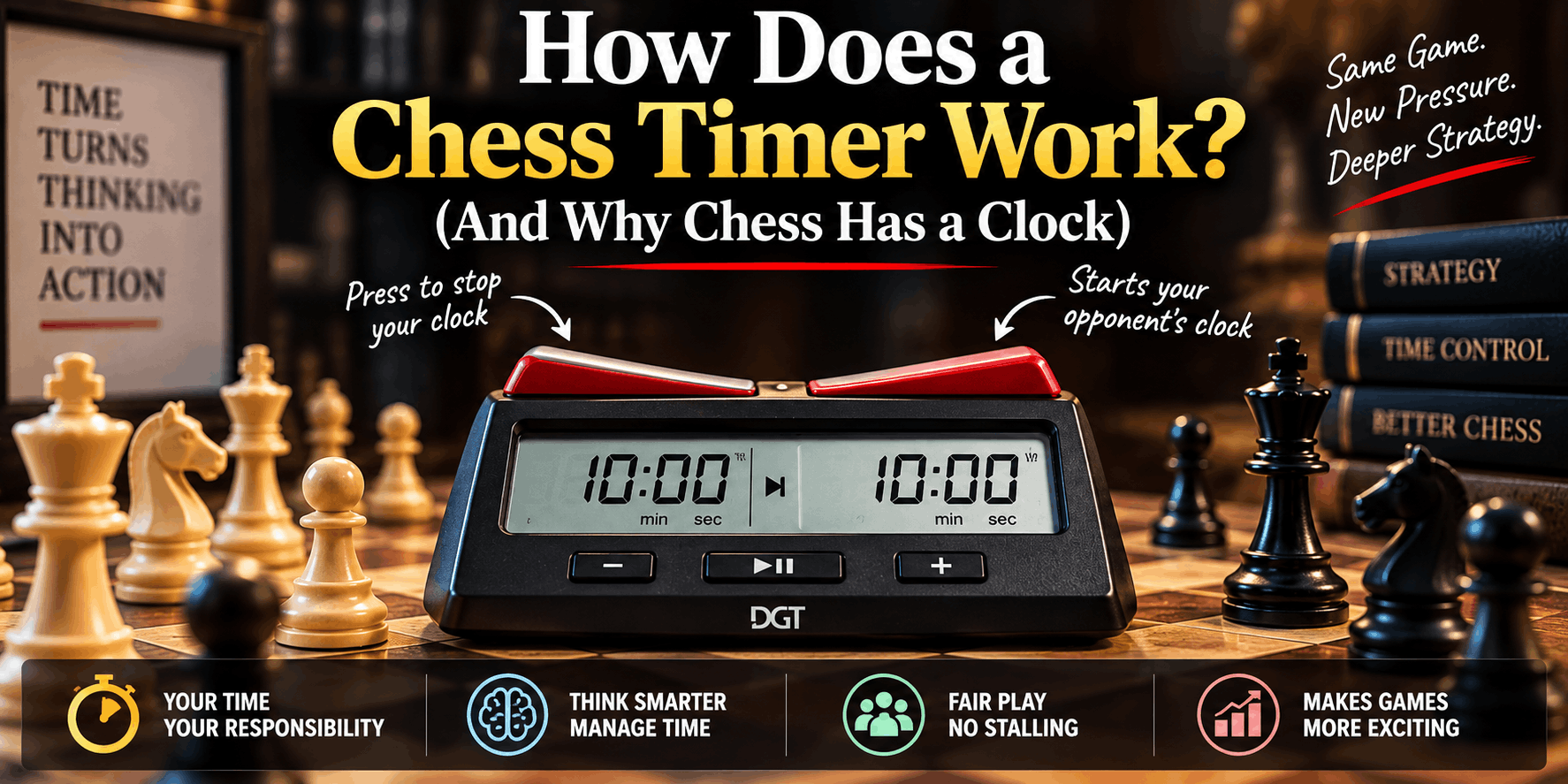
About 2 hours for each game, though it can go past 3 at times.
For FIDE classical time controls, the first 40 moves are played with 90 minutes. Once move 40 is done, the clock drops to 30 minutes for the remaining moves. After that point, you also get 30 extra seconds each time you make a move.
In a 60 move game, you usually get around 2 and a half hours to think. Your opponent gets the same. There is 5 hours in the afternoon before everyone shakes hands.
The standard control, decoded
You might see it written like 90'/40 + 30' + 30". Here’s what each part means:
-
90 minutes for 40 moves. This is your main budget. Burn it before you reach move 40 and you lose, no matter how good your position looks.
-
+30 minutes. The moment you complete move 40, half an hour lands on your clock automatically. Nobody presses anything.
-
+30 seconds per move. Added from the very first move, and it never stops. Even at move 95 with 12 seconds left, you get 30 more every time you press.
That increment is the reason you almost never see a modern grandmaster lose a drawn endgame purely because they couldn't move the pieces fast enough. Before Bobby Fischer patented the increment clock in 1988, that happened constantly.
There is also a longer version approved by FIDE that is used at some elite events: 100 minutes for the first 40 moves, 50 minutes for the next 20 moves and 15 minutes to finish, but with the same 30 second increment.
What that works out to per move
This is the number most players never calculate, and it changes how they play.
If you are playing 90 minutes of music, but the game takes 40 moves, you play at 2 minutes and 15 seconds per move. Now add the increment and you will be at about 2 minutes 45 seconds.
Think about that. Two and three-quarter minutes, on average, for every single move including the ones you've played a thousand times.
So when you spend 20 minutes on move 11, you haven't just spent 20 minutes. You've spent your budget for the next seven moves. Players who understand this arrive at move 30 with time to spare. Players who don't are the ones you see at move 36 with ninety seconds, hands shaking, hanging a rook.
Why 40 moves? The ghost of adjournments
The 40-move mark looks arbitrary until you know where it came from.
Most of the 1900s, classical matches went along at about 2 hours and 30 minutes for 40 moves. If the game was still not over by then, the players would pause it and continue later. The player to move wrote their next move on a slip, sealed it in an envelope, and everybody went to dinner. Play resumed the following day.
Both sides then spent the night analysing with their seconds. Half the drama of old World Championship matches lived in those sealed envelopes.
Computers killed it. Long ago, a laptop could play an endgame after a stop better than groups of grandmasters. Once that happened, the long pauses seemed pointless. FIDE then stopped using those adjournments by the end of the 1990s. The 40-move checkpoint survived, now serving as a bonus-time gate instead of a bedtime.
That's also why "move 40" is the most stressful moment in tournament chess. Everything before it is a countdown to a hard wall.
The classical controls you'll actually run into
| Event type | Time control | Roughly per player |
|---|---|---|
| FIDE standard | 90'/40 + 30' + 30" | 2h 00m to 2h 30m |
| World Championship | 120'/40 + 60'/20 + 15' + 30" from move 61 | About 3 hours |
| Chess Olympiad | 90'/40 + 30' + 30" | 2h 00m to 2h 30m |
| Club weekend Swiss | 90' + 30" or G/120 | Around 2 hours |
| Lower-rated FIDE events | 60' or 90' + 30" | 1h to 2h |
World Championship games regularly cross six hours of combined play. When you read about a match game finishing after seven hours, it isn't an exaggeration.
What officially counts as "classical"
FIDE doesn't define classical by feel. For a game to be rated on the standard list, each player needs a minimum amount of time calculated as though the game will last 60 moves (so base time plus 60 increments). The threshold moves with the strength of the players:
-
You should play with a minimum of 120 minutes per game with at least one player rated 2200+
-
Two or more players rated 1600+ or higher: play is 90 minutes or less per player
-
Both players under 1600: min 60 minutes each
Now you're on other ground! For each player, the game is called “rapid” when the time is over 10 minutes but under 60 minutes. It is called “blitz” when the time is at least 5 minutes and no more than 10 minutes.
For the 60-move part, you add G/90 and 30 minutes. That gives 90 plus 30, which is 120 minutes. So even a top level 90 can be finished in 120 minutes. Neat design, not a coincidence.
Is there a way that a classical game can have no time?
No, due to the increment. You'll earn 30 seconds as long as you move. There can be no "starvation out."
All you can do is tire people out. The longest game played in a tournament is held by Nikolić and Arsović at Belgrade in 1989, 269 moves (20h 15min) and a draw.
In practice, games are finite with the help of two safety valves. If either side doesn't move a pawn and doesn't capture for 50 moves, the 50 move rule terminates. If a position repeats itself 3 times, a count that continues until 300 moves are played, the threefold repetition rule terminates. With them a stubborn pair could go on forever.
How to actually budget two hours
Having the time is easy. Using it is the skill. Try this framework in your next classical game:
-
Reach move 15 with at least 60 minutes left. Openings are preparation, not calculation. If you're thinking hard on move 8, your preparation has a gap and you should fix it after the game, not during it.
-
Spend the big think where the position changes. There's usually one moment, often between moves 18 and 25, where pawn structure locks or a piece trade defines the rest of the game. That's worth 15 minutes. Move 6 is not.
-
Set a floor at move 30. Fifteen minutes minimum. If you're below it, you've already lost the time battle and need to start playing faster, decent moves instead of hunting for perfect ones.
-
Treat the 30-minute bonus as a real second game. Plenty of players relax after move 40 and blunder within three moves. The clock pressure lifts, the concentration lifts with it.
-
Write down your clock time every ten moves. Old-fashioned, effective. Most tournament scoresheets have a column for exactly this.
Honestly, the fastest improvement for most club players isn't a new opening. It's spending that 90 minutes in the right places.
FAQ
How long does a classical chess game last in real hours?
Usually four to five hours for a full-length game. Short draws end in 40 minutes, World Championship games can run past seven.
Is 90+30 considered classical?
Yes. It comes to 120 minutes on FIDE's 60-move calculation, which qualifies for standard rating at every level.
Do players get a break during a classical game?
There's no scheduled break. You can leave the board whenever you want, but your clock keeps running. Most players take short walks on the opponent's time.
Is G/60 classical or rapid?
G/60 with no increment falls just inside the rapid band by FIDE's definition. Add a 30-second increment and it becomes 90 minutes on the calculation, which makes it standard-rated.
Why does classical chess take so long?
Because the positions justify it. A single middlegame decision can hide six-move tactics for both sides, and classical exists so the better player wins on understanding rather than on reflexes.