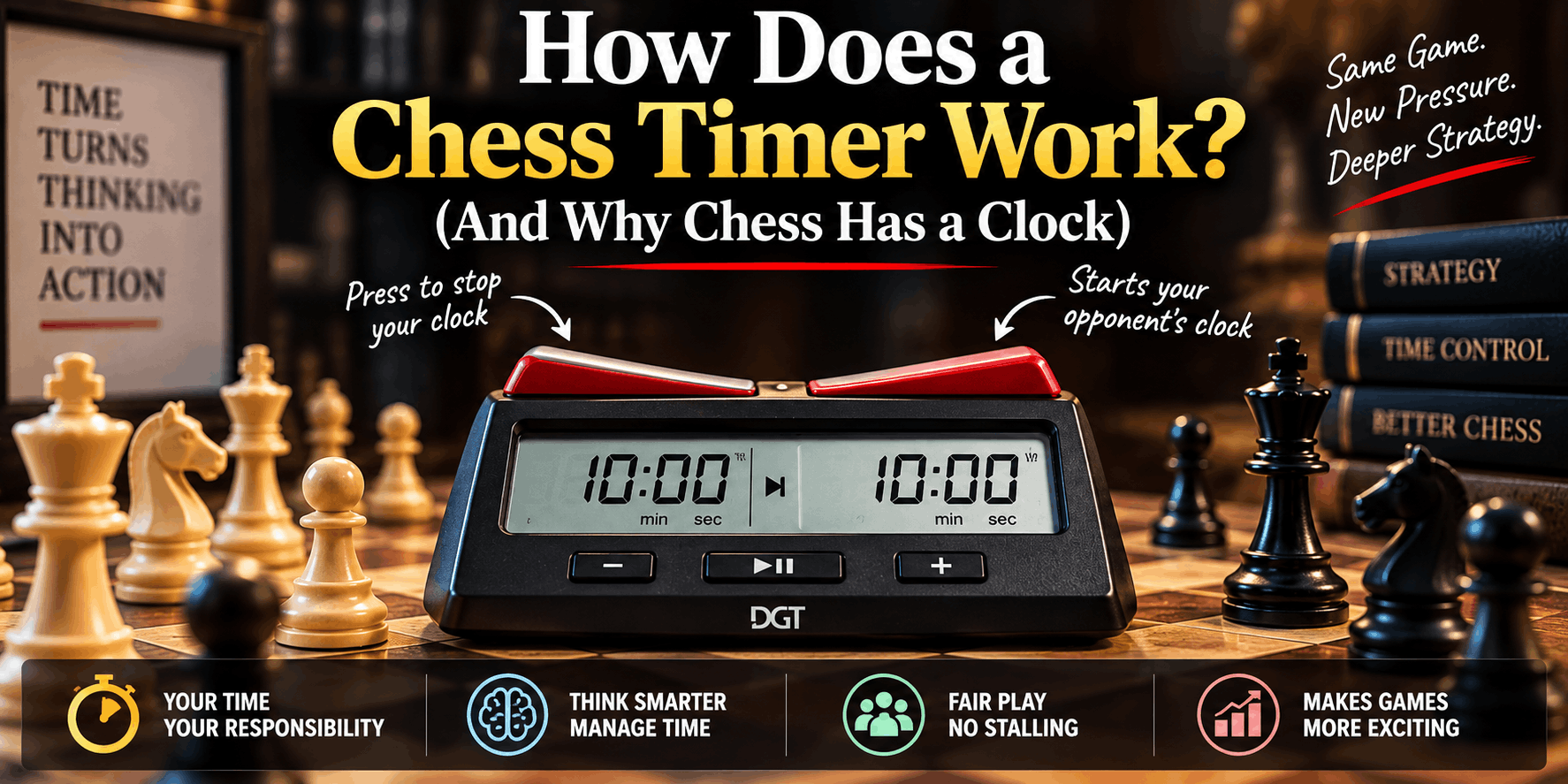
The free guide provides expert tips to help you understand chess timer operations and select appropriate time controls for your skill level and learn professional clock management techniques.
Most chess players lose on time before they even realize what happened. You've calculated a beautiful sequence, the position is objectively winning — and then your clock hits zero. Game over. It's one of the most frustrating ways to lose, and it happens constantly to players who never practiced with a timer. This guide changes that.
What Actually Is a Chess Timer?
A chess timer — some people call it a chess clock — is a device with two separate countdowns running side by side. Only one runs at a time. You move, press the button, and your clock stops while your opponent's starts. That's the whole mechanic. The pressure it creates, though, is something else entirely.
Chess clocks showed up in competitive play back in 1883. Thomas Bright Wilson brought the first double-sided clock design to the London Chess Tournament because, before that, players were literally using sandglasses. Bobby Fischer later changed the game again in the 1980s when he developed the time increment system — more on that below — which is now the standard at every serious level of play.
Why You Can't Just Skip the Clock
The fairness argument
Without a time limit, there's nothing stopping a player from sitting on a position for hours. Nothing. A chess timer fixes that — both players get identical total time, regardless of style or experience level.
It exposes your weaknesses faster than anything else
Here's something most players don't want to hear: slow games hide bad habits. When you have unlimited time, you can find the right move by process of elimination. Under the clock, you have to know. Practicing with a timer forces you to build genuine chess intuition, not just calculation stamina.
Adrenaline is real
Ask anyone who's played bullet chess why they keep coming back. It's the clock. Ten seconds left, complex position, everything on the line — that feeling doesn't exist without a timer.
Tournaments require it
All FIDE-rated matches require the use of a clock system. Practicing without a timer functions as ineffective training for official competition because it does not prepare you for actual performance. The situation will become most difficult for you when your discomfort reaches its peak.
The Five Time Control Formats (And Who Should Use Each)
| Format | Time Per Player | What It's Good For |
|---|---|---|
| Bullet | Under 3 minutes | Pattern drilling, entertainment |
| Blitz | 3–10 minutes | Tactical sharpness, opening prep |
| Rapid | 10–30 minutes | Real improvement, serious practice |
| Classical | 90+ minutes | Deep preparation, tournament play |
| Correspondence | Days per move | Opening theory, endgame study |
Bullet (Under 3 Minutes)
Bullet chess is chaos, and that's honestly part of the appeal. The most common controls are 1+0 and 2+1. You don't have time to calculate — you're playing on instinct and pattern recognition, and that's it.
It's addictive. It's also not the fastest path to improvement. Fast games can mask real weaknesses because neither player has time to find them. Play bullet for fun, not as your main training format.
Blitz (3–10 Minutes)
Blitz is what most people mean when they say they play chess online. Controls like 3+0, 3+2, 5+0, and 5+3 give you just enough time for short combinations and rough planning — but not for extended deep calculation on every move.
The World Blitz Championship runs at 3+2. If that tells you anything, it's that blitz rewards preparation. Players who know their openings cold and have sharp tactical eyes do well here. Players relying on calculation alone usually don't.
Rapid (10–30 Minutes)
If you want to actually get better at chess, this is where you spend your practice time. Controls like 15+10 or 25+10 give you enough time to work through real plans, navigate middlegame complexity, and think through endgames — without games turning into all-day affairs.
The balance here is just right. Enough pressure to force genuine decisions. Enough time to make them properly.
Classical (90+ Minutes)
This is what you see at the FIDE World Chess Championship and elite open tournaments. A single game can run five to seven hours. The time control starts with 90 minutes to complete the initial 40 moves and provides 30 additional minutes for the remainder of the match while 30 seconds are added after each move starting from the first move.
Classical chess is where endgame technique and strategic planning get tested at the deepest level. The clock and its increments shape entire games at this format.
Correspondence (Days Per Move)
Correspondence chess isn't really about time pressure — it's about depth. Players get days, sometimes up to three, per move. It doesn't use a traditional timer the same way, but there's still a cumulative clock tracking time spent. Best for studying opening theory without the rush.
Digital Clock vs. Analog Clock: An Honest Take
The combination of visual beauty and historical significance makes analog clocks an excellent timekeeping device. The mechanical click of these chess timepieces, which have been used since the 19th century, provides users with a satisfying experience. The system fails to support Fischer increments and Bronstein delays which makes it impossible to read the rapidly moving analog face during bullet scrambles.
Digital clocks are the current competitive standard. They display time down to the millisecond, support every modern time control format, and come pre-loaded with tournament presets. If you're practicing for real games with real time controls, you need a digital clock.
Online timers work fine for casual play and home practice. No purchase required, runs in any browser, supports any time control you want to set. Good option if you're just starting out or playing informally.
How to Use a Chess Timer (Step by Step)
Step 1: Agree on the format first. Decide your time control before anyone touches a piece. Beginners: go with 10+0 or 15+10. Casual games between friends: 5+0 or 5+3 works. Competitive practice: match the format you're preparing for.
Step 2: Set up the clock. Program both sides with identical starting time. If you're using an increment, enter the seconds-per-move bonus. Double-check both sides before you start — a mistake here causes arguments later.
Step 3: White moves first, then presses the clock. This stops White's time and starts Black's. From there, the pattern repeats every move: move, press, opponent's turn.
Step 4: A few rules worth burning into memory. Press the clock with the same hand that moved the piece — always. Press it firmly, not halfway. Never press before finishing your move. Don't touch your opponent's button. If you need to adjust a piece, say "I adjust" first, complete the move, then press.
Step 5: Know how a game actually ends. Checkmate, resignation, draw, stalemate — or one player's clock hits zero. That last one matters more than most beginners realize. If your time runs out and your opponent has enough material to deliver checkmate, you lose. Doesn't matter if you were completely winning on the board. Clock management is part of chess.
10 Clock Habits That Will Actually Help You
1. Move fast in the opening. If you know your opening theory, there's no reason to burn time in the first fifteen moves. Save it for the middlegame positions that actually need thinking.
2. Find the critical moments and spend there. Not every position is equally complex. Learn to identify turning points — a tactical combination, a key piece exchange, a passed pawn decision — and allocate your time accordingly. Everything else, play efficiently.
3. Calculate on your opponent's time. When your opponent is thinking, don't sit there staring at the board. Predict their likely responses, pre-calculate your candidate moves, narrow your decision tree. By the time your clock starts, you should already be halfway to a decision.
4. Don't treat the increment as infinite. A 5+3 control means you gain three seconds per move. That's a buffer, not a safety net. Players who rely entirely on the increment burn their base time and then scramble. Keep your base time healthy throughout.
5. Simplify when you're low on time. Under 30 seconds: skip complicated sacrifices. Find the most solid, sensible move that keeps you in the game. Surviving in a bad position beats flagging in a winning one.
6. Build a quick pre-move check. The three-step routine which strong players use requires them to first observe their opponent's latest move before checking their piece safety and making their final decision. The worst panic mistakes become less likely when people have more than three seconds to process their thoughts.
7. Don't carry a flagged game into the next one. Losing a completely winning position on time is brutal. Every grandmaster has done it. Learn the clock management lesson, reset, and move on. Holding onto it only hurts the next game.
8. Play rated rapid games for improvement. Games in the 10 to 15-minute range give you enough time to think seriously while genuinely training your clock habits. More productive than blitz for most players who want to improve.
9. Practice the format you'll actually play in. If your tournament uses 25+10, don't spend all your prep time on 3-minute blitz. Your opening rhythms, time allocation instincts, and endgame decisions are all format-specific.
10. Know your endgame technique cold. Players who understand basic endgame theory convert positions efficiently when time is short. Players who don't spend their last two minutes guessing what to do on an almost-empty board.
Common Questions About Chess Clocks
What's the basic rule? Each player gets a set amount of time. Only one clock runs at a time. After you move, you press the button — your clock stops, your opponent's starts. Time hits zero with your opponent holding sufficient mating material? You lose.
Bullet vs. blitz vs. rapid — what's the difference? Bullet: under three minutes per player. Blitz: three to ten minutes. Rapid: ten to thirty minutes. Classical: anything above thirty minutes. Less time means more instinct, less calculation. Simple as that.
What is Fischer increment?
The system received its name from World Champion Bobby Fischer who created it during the 1980s. Your clock receives an additional fixed duration of seconds after every move that you make. Players begin a 5+3 game with five minutes of time and receive three seconds of additional time after each move. The system prevents matches from finishing through time-based races at the end while it gives players who execute precise gameplay near their time limits a chance to win.
Best format for a complete beginner?
15+10 and 10+5 serve as starting points. The time provided lets you analyze your moves while preventing excessive game delays. The first games should not use 1-minute bullet because you need to develop your chess skills before you can learn to play faster.
Who invented the chess clock?
The first side-by-side chess clock for chess matches was constructed by Thomas Bright Wilson for the 1883 London Chess Tournament. Players used sandglasses before that time. Fischer's increment system which he developed during the 1980s became the standard for international chess competitions.
What happens when both players reach time expiration at exactly the same time? The result is a draw. FIDE regulations handle this situation although it occurs in actual play. Online play establishes its own time control rules which do not allow simultaneous time expiration.
One Last Thing
The chess timer functions as more than a device which measures time because it serves as essential equipment which transforms chess into a competitive sport. The system trains you to handle stressful situations because it requires you to decide without having all necessary information and to remain composed during critical moments when your situation deteriorates.
Every serious player remembers their first real time scramble because the experience includes panic and blunders and a valuable lesson. The only way through that is reps. Players need to establish time limits while selecting their preferred game format to start playing the game.